DApps

How to Build a dApp: The Complete Development Process

Ashok Rathod

Tech Consultant

Posted on
1st Jun 2026
5 min
Read
Share

Table of Contents

  • Quick Tips
  • Familiarize yourself with Cash App
  • Enable two-factor authentication
  • Utilize the optional Cash App
  • Conclusion

Decentralized applications are no longer a niche experiment. They are actively reshaping how industries operate, from finance and gaming to real estate and digital identity. In 2026, the global blockchain market is projected to surpass $94 billion, with dApp-related development accounting for a significant share of that growth. Over 4 million daily active wallets now interact with dApps globally, and that number continues to climb. As enterprises and startups race to stake their position in this ecosystem, understanding the complete dApp development process has become a foundational business requirement. This guide walks you through every stage of building a dApp, from concept to deployment.

➤ What Is a dApp?

A decentralized application, or dApp, is software that runs on a blockchain network rather than centralized servers. Unlike traditional applications where a single company controls the backend, dApps distribute their logic across a peer-to-peer network using smart contracts.

Key features include decentralization, which removes single points of failure; transparency, since all transactions are publicly verifiable on-chain; automation through contract-driven logic; strong security through cryptographic validation; and token integration that enables native economies within the application.

Popular examples include DeFi lending platforms, NFT marketplaces, blockchain-based games, and DAO governance platforms.

➤ Why Businesses Are Investing in dApp Development

Businesses choose dApps for several strategic reasons. Removing intermediaries reduces costs and speeds up workflows. Every transaction is logged on an immutable ledger, increasing accountability. Smart contract automation enforces business rules without manual oversight. And because blockchains operate globally without geographic restrictions, dApps open markets that traditional platforms cannot reach efficiently.

➤ The Complete dApp Development Process Explained

➥ Step 1: Define the dApp Idea and Use Case

Start by identifying a genuine problem. Adding blockchain to a process that works fine without it is one of the most common and costly mistakes businesses make. Ask whether decentralization actually solves something. From there, choose your dApp type: financial applications, NFT platforms, social networks, gaming ecosystems, or enterprise-grade tools each have different architectural demands.

➥ Step 2: Select the Right Blockchain Network

Your blockchain choice shapes everything downstream. Ethereum remains the most established network with deep smart contract support and developer tooling. Solana handles high transaction volumes at speed. Polygon offers significantly lower gas fees, making it attractive for consumer-facing apps. BNB Chain provides EVM compatibility, and Avalanche stands out for scalability under load.

➥ Step 3: Design the dApp Architecture

A well-structured dApp has three layers. The frontend, typically built with React.js or Next.js, handles the user interface and wallet integration. The smart contract layer contains business logic, token handling, and automated transaction rules. The backend and storage layer uses tools like IPFS for decentralized file storage alongside APIs and indexing services. Wallet connectivity through MetaMask, WalletConnect, or Coinbase Wallet ties everything together.

➥ Step 4: Develop Smart Contracts

Smart contracts are self-executing programs stored on the blockchain. They automate transactions, remove middlemen, and enforce rules without requiring trust between parties. The dominant language for this is Solidity programming language, used extensively on Ethereum-compatible chains, while Rust is common on Solana. The development process involves writing contract logic, testing all functions, deploying to a testnet, and then conducting a code review before mainnet launch.

Also Read: What Is dApp in Blockchain? Meaning, Examples, and How It Works

➥ Step 5: Build the Frontend Interface

Many technically sound dApps fail simply because their interfaces are confusing. Poor usability is a leading cause of dApp abandonment. The frontend should be built with React, Web3.js, or Ethers.js, and must include clear components for wallet connection, a transaction dashboard, token balances, and NFT displays where relevant. Mobile responsiveness is not optional; a large and growing share of Web3 users interact entirely through mobile devices.

➥ Step 6: Integrate Wallets and Blockchain Connectivity

Wallet integration is the bridge between your user and the blockchain. It enables both authentication and transactions without requiring account creation in the traditional sense. MetaMask is the most widely supported option on desktop; Trust Wallet and Phantom Wallet serve mobile-first and Solana users respectively. The transaction flow involves wallet connection, user-signed approval, and on-chain confirmation.

➥ Step 7: Test the dApp Thoroughly

Testing must happen across three dimensions. Smart contracts need unit testing and security-focused reviews to catch logic errors before they become exploits. Frontend testing covers UI validation and cross-device responsiveness. Blockchain testing uses testnets and transaction simulations to replicate real network conditions. Skipping or rushing this phase is where projects create serious vulnerabilities. A professional smart contract audit is the final checkpoint before any production deployment, and it is not a step to skip regardless of timeline pressure.

➥ Step 8: Deploy the dApp

Mainnet deployment makes your contracts live and permanent. The frontend can be hosted through decentralized options or traditional cloud services. Configure SSL, a CDN, and monitoring tools from day one. After launch, track performance, contract activity, and user behavior continuously to catch issues early.

➤ Best Practices for Successful dApp Development

Focus heavily on user experience; a dApp that users cannot navigate intuitively will not retain them. Keep smart contracts as lean and simple as possible since complexity introduces risk. Build with scalability in mind so your architecture handles growth without requiring a full rebuild. Multi-chain compatibility is increasingly important as users operate across different networks.

➤ Final Summary

Building a dApp is a structured process that requires clarity at every stage: a well-defined problem, the right network, a layered architecture, secure contracts, a usable interface, and thorough testing before launch. Teams that want to hire dapp developers should prioritize professionals with proven security knowledge and testnet experience, not just coding ability. Security, scalability, and usability are not afterthoughts. They are the foundation on which every successful decentralized application is built. When approached with discipline, dApp development becomes one of the most powerful tools available for building products that are open, resilient, and ready for a decentralized future.
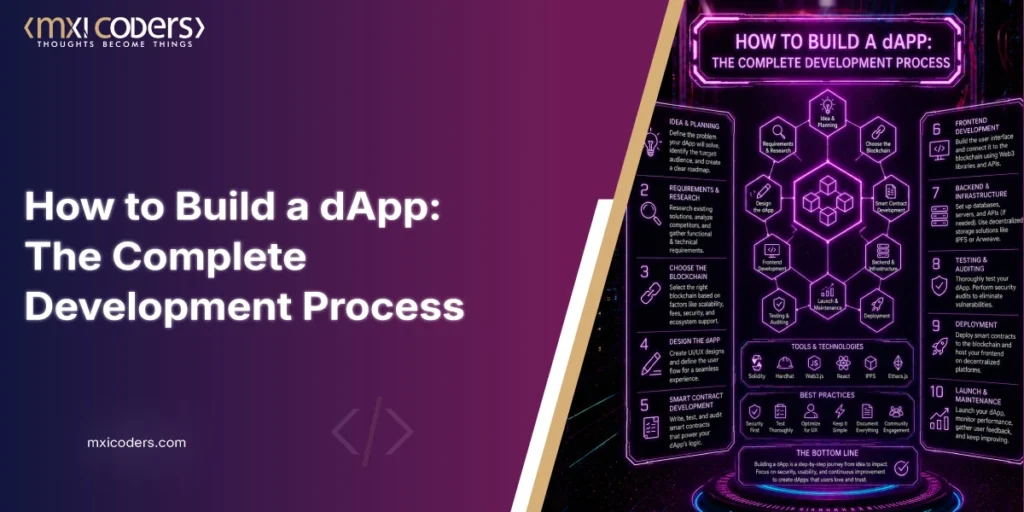

how to build a dapp

Decentralized applications are no longer a niche experiment. They are actively reshaping how industries operate, from finance and gaming to real estate and digital identity. In 2026, the global blockchain market is projected to surpass $94 billion, with dApp-related development accounting for a significant share of that growth. Over 4 million daily active wallets now interact with dApps globally, and that number continues to climb. As enterprises and startups race to stake their position in this ecosystem, understanding the complete dApp development process has become a foundational business requirement. This guide walks you through every stage of building a dApp, from concept to deployment.

➤ What Is a dApp?

A decentralized application, or dApp, is software that runs on a blockchain network rather than centralized servers. Unlike traditional applications where a single company controls the backend, dApps distribute their logic across a peer-to-peer network using smart contracts.

Key features include decentralization, which removes single points of failure; transparency, since all transactions are publicly verifiable on-chain; automation through contract-driven logic; strong security through cryptographic validation; and token integration that enables native economies within the application.

Popular examples include DeFi lending platforms, NFT marketplaces, blockchain-based games, and DAO governance platforms.

➤ Why Businesses Are Investing in dApp Development

Businesses choose dApps for several strategic reasons. Removing intermediaries reduces costs and speeds up workflows. Every transaction is logged on an immutable ledger, increasing accountability. Smart contract automation enforces business rules without manual oversight. And because blockchains operate globally without geographic restrictions, dApps open markets that traditional platforms cannot reach efficiently.

➤ The Complete dApp Development Process Explained

➥ Step 1: Define the dApp Idea and Use Case

Start by identifying a genuine problem. Adding blockchain to a process that works fine without it is one of the most common and costly mistakes businesses make. Ask whether decentralization actually solves something. From there, choose your dApp type: financial applications, NFT platforms, social networks, gaming ecosystems, or enterprise-grade tools each have different architectural demands.

➥ Step 2: Select the Right Blockchain Network

Your blockchain choice shapes everything downstream. Ethereum remains the most established network with deep smart contract support and developer tooling. Solana handles high transaction volumes at speed. Polygon offers significantly lower gas fees, making it attractive for consumer-facing apps. BNB Chain provides EVM compatibility, and Avalanche stands out for scalability under load.

➥ Step 3: Design the dApp Architecture

A well-structured dApp has three layers. The frontend, typically built with React.js or Next.js, handles the user interface and wallet integration. The smart contract layer contains business logic, token handling, and automated transaction rules. The backend and storage layer uses tools like IPFS for decentralized file storage alongside APIs and indexing services. Wallet connectivity through MetaMask, WalletConnect, or Coinbase Wallet ties everything together.

➥ Step 4: Develop Smart Contracts

Smart contracts are self-executing programs stored on the blockchain. They automate transactions, remove middlemen, and enforce rules without requiring trust between parties. The dominant language for this is Solidity programming language, used extensively on Ethereum-compatible chains, while Rust is common on Solana. The development process involves writing contract logic, testing all functions, deploying to a testnet, and then conducting a code review before mainnet launch.

Also Read: What Is dApp in Blockchain? Meaning, Examples, and How It Works

➥ Step 5: Build the Frontend Interface

Many technically sound dApps fail simply because their interfaces are confusing. Poor usability is a leading cause of dApp abandonment. The frontend should be built with React, Web3.js, or Ethers.js, and must include clear components for wallet connection, a transaction dashboard, token balances, and NFT displays where relevant. Mobile responsiveness is not optional; a large and growing share of Web3 users interact entirely through mobile devices.

➥ Step 6: Integrate Wallets and Blockchain Connectivity

Wallet integration is the bridge between your user and the blockchain. It enables both authentication and transactions without requiring account creation in the traditional sense. MetaMask is the most widely supported option on desktop; Trust Wallet and Phantom Wallet serve mobile-first and Solana users respectively. The transaction flow involves wallet connection, user-signed approval, and on-chain confirmation.

➥ Step 7: Test the dApp Thoroughly

Testing must happen across three dimensions. Smart contracts need unit testing and security-focused reviews to catch logic errors before they become exploits. Frontend testing covers UI validation and cross-device responsiveness. Blockchain testing uses testnets and transaction simulations to replicate real network conditions. Skipping or rushing this phase is where projects create serious vulnerabilities. A professional smart contract audit is the final checkpoint before any production deployment, and it is not a step to skip regardless of timeline pressure.

➥ Step 8: Deploy the dApp

Mainnet deployment makes your contracts live and permanent. The frontend can be hosted through decentralized options or traditional cloud services. Configure SSL, a CDN, and monitoring tools from day one. After launch, track performance, contract activity, and user behavior continuously to catch issues early.

➤ Best Practices for Successful dApp Development

Focus heavily on user experience; a dApp that users cannot navigate intuitively will not retain them. Keep smart contracts as lean and simple as possible since complexity introduces risk. Build with scalability in mind so your architecture handles growth without requiring a full rebuild. Multi-chain compatibility is increasingly important as users operate across different networks.

➤ Final Summary

Building a dApp is a structured process that requires clarity at every stage: a well-defined problem, the right network, a layered architecture, secure contracts, a usable interface, and thorough testing before launch. Teams that want to hire dapp developers should prioritize professionals with proven security knowledge and testnet experience, not just coding ability. Security, scalability, and usability are not afterthoughts. They are the foundation on which every successful decentralized application is built. When approached with discipline, dApp development becomes one of the most powerful tools available for building products that are open, resilient, and ready for a decentralized future.

Feel free to Connect us on

Ready to transform your business with smart software solutions?

Harness the power of custom software development to streamline operations, reduce costs, and boost efficiency. Start by exploring cutting-edge approaches like cloud-native platforms, API-first architecture, and AI-driven automation to future-proof your systems and stay ahead of the competition.

Book free consultation

Let’s build your idea together and serve society.

Author

Ashok Rathod

Tech Consultant

Experience
25 Years
Growth Architect for Startups & SMEs | Blockchain, AI , MVP Development, & Data-Driven Marketing Expert.

Transform the Carbon Credit Industry

Build a Transparent, Scalable Carbon Credit Marketplace with Blockchain.

Index