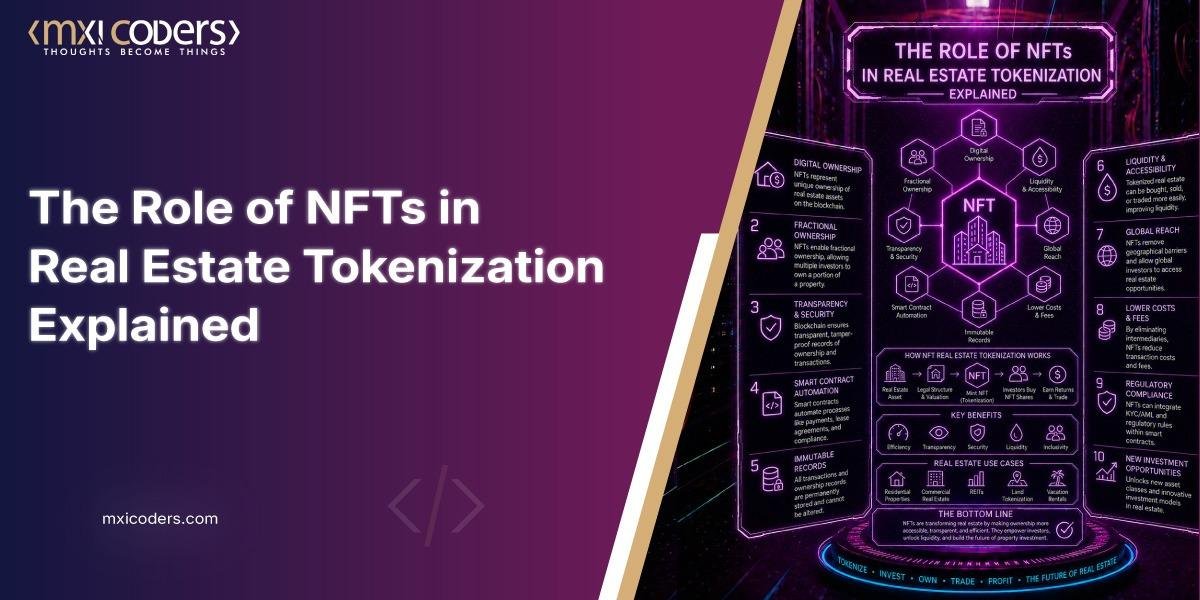
Real estate has long been considered one of the most stable investment classes but also one of the least accessible. High entry costs, slow transaction processes, and geographic limitations have kept millions of potential investors on the sidelines. That is beginning to change. The global real estate tokenization market was valued at approximately $3.8 billion in 2024 and is projected to exceed $26 billion by 2034, reflecting a sharp rise in institutional and retail interest alike. Meanwhile, blockchain technology is quietly reshaping how ownership is recorded, transferred, and verified across industries and real estate is no exception.
Most people still associate NFTs with digital art and profile pictures. But non-fungible tokens have a far broader range of applications; including the ability to represent ownership rights, property records, and unique real estate assets on a blockchain. This article breaks down exactly how NFTs fit into the real estate tokenization ecosystem, what they make possible, and where this technology is heading.
➤ What Is Real Estate Tokenization?
Real estate tokenization is the process of converting ownership rights of a physical property into digital tokens recorded on a blockchain. Rather than buying or selling an entire property in a single transaction, tokenization makes real estate assets divisible allowing multiple investors to hold fractional stakes in a single building, commercial space, or plot of land. Compared to traditional property ownership, this structure dramatically improves liquidity by enabling tokens to be traded without the lengthy legal processes typically required in real estate transactions.
How Real Estate Tokenization Works
The process begins with selecting a suitable property asset and determining its total value. Legal structuring follows this is where compliance frameworks are established, ownership entities are formed, and regulatory requirements are addressed based on the jurisdiction. Once the legal layer is in place, digital tokens representing shares of ownership are created on a blockchain network. Investors can then purchase these tokens through a platform, and depending on the token type and platform rules, they may trade them on secondary markets.
Key Takeaways:
- Enables fractional ownership of high-value properties
- Improves accessibility for a broader range of investors
- Streamlines asset management and ownership transfers
➤ What Are NFTs and How Do They Work?
➥ Understanding Non-Fungible Tokens (NFTs)
A non-fungible token is a unique digital asset recorded on a blockchain that cannot be replicated or exchanged on a one-to-one basis with another token. Unlike fungible assets where one unit is interchangeable with another, as with currency non-fungible assets carry distinct characteristics that make each one individually identifiable. This uniqueness is enforced and verified through blockchain technology, which maintains a permanent, tamper-proof record of each token and its ownership history.
➥ Core Characteristics of NFTs
NFTs carry several properties that make them particularly useful beyond digital collectibles:
- Uniqueness — Each NFT has a distinct identifier that sets it apart from every other token.
- Verifiable ownership — Ownership can be confirmed publicly without relying on a centralized authority.
- Transparency — All transactions are recorded on a public ledger and accessible to anyone.
- Programmability — NFTs can carry embedded logic that triggers actions under defined conditions.
- Immutable records — Once recorded, the data associated with an NFT cannot be altered retroactively.
Example applications include digital certificates, intellectual property documentation, membership access rights, and increasingly real estate ownership documentation.
Also Read: Solana Blockchain Tokenization Capabilities Explained
➤ The Role of NFTs in Real Estate Tokenization
➥ Representing Unique Property Ownership
No two properties are identical. A commercial unit on the third floor of a building has a different legal identity, value, and set of characteristics than the unit beside it. NFTs are naturally suited to capture this uniqueness. Each property or property fraction can be issued as a distinct NFT that serves as a digital ownership certificate one that is cryptographically secured and resistant to tampering. This creates a verifiable ownership record that doesn’t depend on paper deeds or centralized registries to confirm legitimacy.
➥ Storing Property Metadata
Beyond simply confirming ownership, NFTs can carry detailed property metadata directly within the token or linked securely to it. This includes property information such as size, location, and zoning classification; ownership history from the original title holder through every subsequent transfer; references to legal documentation; and a complete record of transactions associated with that asset. This embedded data layer transforms an NFT from a simple certificate into a comprehensive property record.
➥ Facilitating Ownership Transfers
Traditional property transfers involve weeks of legal work, multiple intermediaries, and significant administrative costs. NFT-based transfers can compress this process considerably. When ownership of a tokenized property changes hands, the transfer is executed and verified on the blockchain reducing paperwork, eliminating redundant verification steps, and creating an instant record of the transaction. The role that smart contract working plays here is significant: pre-programmed conditions can automate the execution of a transfer once payment and compliance checks are satisfied, removing the need for manual processing at each step.
➥ Enhancing Transparency and Trust
One of the most significant advantages NFTs bring to real estate is the ability to create public, traceable ownership records. Any party can verify who owns a tokenized asset, review its transaction history, and confirm that records haven’t been altered. This reduces information asymmetry a longstanding problem in traditional real estate markets where buyers, sellers, and intermediaries often operate with different levels of information.
➥ Benefits at a Glance:
- Reliable ownership verification
- Secure and permanent record keeping
- Simplified and faster ownership transfers
- Increased market transparency
➤ The Future of NFTs in Real Estate Tokenization
➥ Integration With Digital Property Registries
Several governments are already exploring blockchain-based land registries as part of broader modernization initiatives. When national or municipal property registries migrate to blockchain infrastructure, NFTs become a natural fit for representing legal title creating a direct link between government records and on-chain ownership data that is both authoritative and instantly accessible.
➥ Growth of Tokenized Real Estate Platforms
Institutional participation in tokenized real estate is growing as regulatory frameworks become clearer and platforms mature. This increased involvement is bringing greater credibility and capital to the space, while also expanding access for smaller investors who previously lacked entry points into commercial or premium residential assets. Among the blockchain technology benefits driving this growth is the ability to settle transactions faster and with greater auditability than legacy financial infrastructure allows.
➥ Smart Contract-Driven Property Management
Looking ahead, a smart contract development agency working in the real estate space could build systems capable of automating rent collection, distributing revenue proportionally among token holders, and executing ownership transfers and all without manual intervention. These automated systems reduce administrative overhead and minimize the risk of human error in ongoing property management.
➤ Conclusion
NFTs complement real estate tokenization by solving one of its most fundamental requirements, representing unique ownership in a verifiable, transparent, and tamper-resistant way. Together, they offer benefits that traditional real estate infrastructure simply cannot match: traceable ownership histories, automated transaction execution, and open access to records that have historically been fragmented or opaque.
Regulatory and legal challenges remain real. Questions around jurisdiction, investor classification, and the legal enforceability of on-chain ownership still need clearer answers in most markets. But the direction is clear. As digital infrastructure matures and adoption grows, NFTs have the potential to become a foundational component of future real estate ecosystems not a novelty, but a standard part of how property is owned, recorded, and transferred.