[ Your Headline ] [ Highlight Word ]

[ One or two lines describing the offer — e.g. "Experience our services with a FREE 30-minute consultation." ]

[ Optional second line, e.g. "Have a concept in mind? Let's brainstorm together!" ]

Google ★★★★★ 4.8
GoodFirms ★★★★★ 4.7
Clutch ★★★★★ 5.0
Blockchain

How DeFi Apps Are Transforming Traditional Finance

Ashok Rathod

Tech Consultant

Posted on
15th Jul 2026
7 min
Read
Share

Table of Contents

  • Quick Tips
  • Familiarize yourself with Cash App
  • Enable two-factor authentication
  • Utilize the optional Cash App
  • Conclusion

A decentralized finance platform is software built on a blockchain that replicates banking functions, lending, borrowing, trading, and payments, using smart contracts instead of a bank or broker as the middleman. Users interact directly with code that executes automatically once conditions are met, which removes the central authority that traditional finance depends on.

That single design choice, no central authority, is the reason DeFi apps have grown from a niche experiment into a market still measured in the tens of billions of dollars, even after a rough year. According to DeFiLlama, total value locked across DeFi protocols stood at $71.77 billion across 453 chains as of June 18, 2026, down from a January 2026 peak, reflecting a year that’s been tough on yields and risk appetite across the sector. CoinLaw

➤ What Makes a DeFi App Different From a Bank?

Traditional finance relies on institutions to verify identity, hold custody of funds, and approve transactions. Blockchain finance flips that model. Ownership and transaction history live on a public ledger, and smart contracts, self-executing code that runs exactly as written, replace the manual approval steps a bank teller or loan officer would normally handle.

This matters for a few concrete reasons. First, settlement happens continuously rather than during business hours. Second, anyone with a wallet can access lending or trading markets without a credit check or a physical branch. Third, the rules governing a loan or a trade are visible on chain before you commit to them, rather than buried in a term sheet.

The trade-off is that when something goes wrong, there’s no branch manager to call. That’s a real limitation, and it’s worth sitting with before assuming DeFi is a frictionless upgrade over traditional banking.

➤ How Does Crypto Lending Actually Work?

Crypto lending on decentralized platforms works through overcollateralization. A borrower deposits crypto assets worth more than the loan they want, and a smart contract holds that collateral until the loan is repaid. If the value of the collateral drops below a set threshold, the contract liquidates it automatically to protect lenders, no negotiation, no grace period email.

This is different from a traditional loan, where a bank assesses your income and credit history. In DeFi lending, the collateral does the underwriting. That’s what makes permissionless access possible, and it’s also why crypto lending is inherently more volatile than a mortgage or personal loan; the system reacts instantly to price swings.

Lending is currently one of the largest categories in DeFi. DeFiLlama’s lending-specific tracking put the category at roughly $54 billion in deposits across more than 380 protocols as of April 2026, with the market fragmented across a handful of dominant platforms rather than concentrated in one. Eco

➤ Comparing the Major Lending Architectures

OptionMechanismBest fitTrade-off
Pooled lending (Aave-style)Suppliers deposit into a shared pool; borrowers draw against it at a variable rateDepositors who want deep liquidity and the longest audit historyRates dilute across all borrowers in the pool rather than matching specific risk
Isolated markets (Morpho-style)Each market is defined by one collateral asset, one loan asset, and fixed parameters that can’t be changed after deploymentUsers who want to concentrate risk and yield around a specific asset pairLess diversification; a problem in one isolated market doesn’t spread, but neither does its liquidity
Governance-aligned lending (Spark-style)Rates track a parent protocol’s savings rate, passed through to lendersDepositors who want yield tied to a broader, more established ecosystemYield is somewhat dependent on the parent protocol’s governance decisions

Aave remains the largest single platform in this space, handling close to 48% of all active DeFi loans as of early 2026, which is one reason it’s often the default reference point when people compare crypto lending options. Techloy

➤ Why Are Businesses Actually Adopting DeFi Apps?

Companies are experimenting with DeFi apps for a narrower set of reasons than the marketing suggests. Real-time settlement removes the multi-day delay of traditional cross-border payments. Programmable smart contracts let a business automate recurring payments or revenue splits without manual processing. And composability, the ability for one DeFi app to plug directly into another, lets a business stack lending, trading, and custody tools without building each from scratch.

None of that means DeFi is a drop-in replacement for a bank account. It means specific functions, payments, lending, and asset management, can be handled more cheaply and transparently in narrow use cases, especially for companies already comfortable holding crypto assets.

➤ What Are the Real Risks of DeFi Apps?

This is the part most DeFi content glosses over, and it shouldn’t be. Smart contract risk is not theoretical. Hacken’s Q1 2026 Web3 security report found $482.6 million lost across 44 incidents in the first quarter alone, and six of those exploited protocols had already passed a formal audit. An audit reduces risk. It doesn’t eliminate it. Svrn

Regulatory uncertainty is the other major gap. In the United States, the SEC and CFTC issued a joint Interpretive Release on March 17, 2026, the first major coordinated statement clarifying how federal securities laws apply to crypto assets and transactions, following a Memorandum of Understanding the two agencies signed earlier that month. That’s meaningful progress, but it’s guidance, not comprehensive legislation, and DeFi lending protocols specifically still sit in a gray area because there’s no company or customer relationship for a regulator to point to the way there is with a centralized platform. Latham & Watkins

Liquidity and volatility risk round this out. Because DeFi lending is collateral-driven, a sharp market drop can trigger cascading liquidations across multiple protocols at once, which is a different kind of systemic risk than anything in traditional banking.

➤ Limitations and Open Questions

DeFi apps are not yet a full substitute for traditional finance, and treating them as one is premature. Smart contract audits materially reduce, but do not eliminate, exploit risk. Regulatory frameworks in the US, EU, and elsewhere remain fragmented rather than harmonized, which means compliance requirements can shift depending on jurisdiction. And DeFi’s total value locked has proven far more volatile year to year than deposits in a traditional bank, which matters if you’re evaluating it as a place to park capital rather than a tool to use selectively.

➤ Frequently asked questions

  1. Is DeFi lending safer than a traditional bank loan?
    Not in the way most people mean “safer.” There’s no deposit insurance and no institution to appeal to if a smart contract behaves unexpectedly. What DeFi lending offers instead is transparency, you can see the contract’s rules before you use it, and speed, since liquidation and settlement happen automatically rather than through a manual review process.
  2. Do I need to trust a company to use a DeFi app?
    You’re trusting code and, indirectly, whoever audited it, rather than trusting a company’s balance sheet or customer service team. That’s a meaningfully different kind of trust, and it’s why audit history and time in production matter more in DeFi than a brand name does.
  3. Can traditional banks build their own DeFi-style products?
    Some are experimenting with tokenized deposits and blockchain-based settlement rails, but a bank offering these still operates under banking regulation, which is a different model than a permissionless protocol with no central operator. The two are converging in places, but they aren’t interchangeable yet.

➤ Conclusion

DeFi apps haven’t replaced traditional finance, and the honest read on the data is that 2026 has been a consolidation year rather than a breakout one for the sector. What’s changed is that the conversation has matured. Smart contracts and crypto lending platforms now compete on measurable ground, audit history, collateral design, regulatory posture, rather than on the promise of disruption alone. For businesses and individuals evaluating blockchain finance, the practical question isn’t whether DeFi will replace banks. It’s which specific function, lending, settlement, or programmable payments, is worth handling on chain today, given the real trade-offs in security and regulatory clarity that still exist.

For teams building on these platforms rather than just researching them, Mxicoders works on smart contract development and DApp development for companies moving specific functions onto blockchain rails. If you’re further along and evaluating a full platform build, our blockchain consulting work covers architecture decisions like the ones compared above. Book a free consultation to talk through what’s actually worth building versus what’s still too early.

➤ Sources Used

  • DeFiLlama, Total Value Locked (TVL) Data (June 18, 2026, via CoinLaw)
  • DeFiLlama, Lending Category Data (April 2026, via Eco Support)
  • Techloy, “Aave, Morpho and Beyond: How to Compare Lending Rates Across Protocols” (Early 2026)
  • Hacken, Q1 2026 Web3 Security Report
  • Latham & Watkins, US Crypto Policy Tracker – SEC-CFTC Interpretive Release (March 17, 2026)
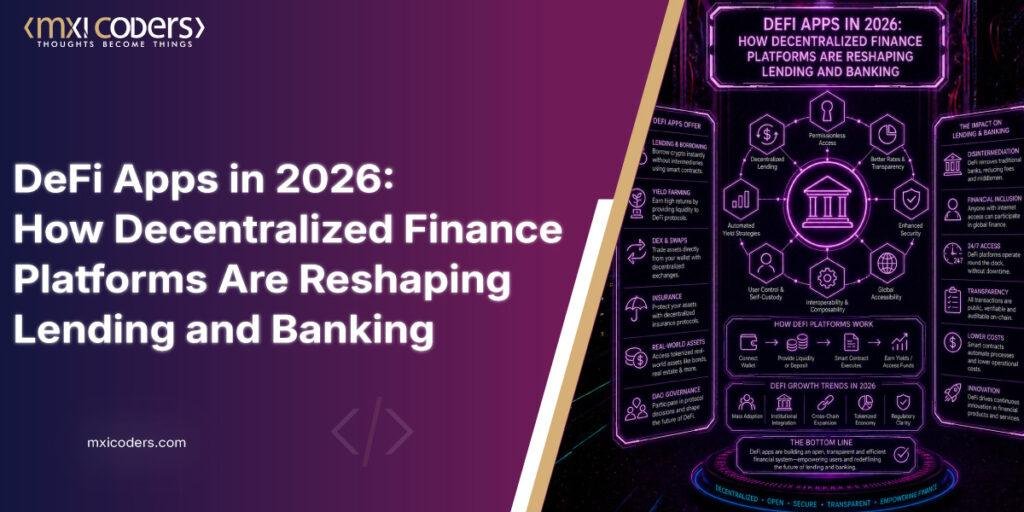
defi apps in 2026 (blog image)

A decentralized finance platform is software built on a blockchain that replicates banking functions, lending, borrowing, trading, and payments, using smart contracts instead of a bank or broker as the middleman. Users interact directly with code that executes automatically once conditions are met, which removes the central authority that traditional finance depends on.

That single design choice, no central authority, is the reason DeFi apps have grown from a niche experiment into a market still measured in the tens of billions of dollars, even after a rough year. According to DeFiLlama, total value locked across DeFi protocols stood at $71.77 billion across 453 chains as of June 18, 2026, down from a January 2026 peak, reflecting a year that’s been tough on yields and risk appetite across the sector. CoinLaw

➤ What Makes a DeFi App Different From a Bank?

Traditional finance relies on institutions to verify identity, hold custody of funds, and approve transactions. Blockchain finance flips that model. Ownership and transaction history live on a public ledger, and smart contracts, self-executing code that runs exactly as written, replace the manual approval steps a bank teller or loan officer would normally handle.

This matters for a few concrete reasons. First, settlement happens continuously rather than during business hours. Second, anyone with a wallet can access lending or trading markets without a credit check or a physical branch. Third, the rules governing a loan or a trade are visible on chain before you commit to them, rather than buried in a term sheet.

The trade-off is that when something goes wrong, there’s no branch manager to call. That’s a real limitation, and it’s worth sitting with before assuming DeFi is a frictionless upgrade over traditional banking.

➤ How Does Crypto Lending Actually Work?

Crypto lending on decentralized platforms works through overcollateralization. A borrower deposits crypto assets worth more than the loan they want, and a smart contract holds that collateral until the loan is repaid. If the value of the collateral drops below a set threshold, the contract liquidates it automatically to protect lenders, no negotiation, no grace period email.

This is different from a traditional loan, where a bank assesses your income and credit history. In DeFi lending, the collateral does the underwriting. That’s what makes permissionless access possible, and it’s also why crypto lending is inherently more volatile than a mortgage or personal loan; the system reacts instantly to price swings.

Lending is currently one of the largest categories in DeFi. DeFiLlama’s lending-specific tracking put the category at roughly $54 billion in deposits across more than 380 protocols as of April 2026, with the market fragmented across a handful of dominant platforms rather than concentrated in one. Eco

➤ Comparing the Major Lending Architectures

OptionMechanismBest fitTrade-off
Pooled lending (Aave-style)Suppliers deposit into a shared pool; borrowers draw against it at a variable rateDepositors who want deep liquidity and the longest audit historyRates dilute across all borrowers in the pool rather than matching specific risk
Isolated markets (Morpho-style)Each market is defined by one collateral asset, one loan asset, and fixed parameters that can’t be changed after deploymentUsers who want to concentrate risk and yield around a specific asset pairLess diversification; a problem in one isolated market doesn’t spread, but neither does its liquidity
Governance-aligned lending (Spark-style)Rates track a parent protocol’s savings rate, passed through to lendersDepositors who want yield tied to a broader, more established ecosystemYield is somewhat dependent on the parent protocol’s governance decisions

Aave remains the largest single platform in this space, handling close to 48% of all active DeFi loans as of early 2026, which is one reason it’s often the default reference point when people compare crypto lending options. Techloy

➤ Why Are Businesses Actually Adopting DeFi Apps?

Companies are experimenting with DeFi apps for a narrower set of reasons than the marketing suggests. Real-time settlement removes the multi-day delay of traditional cross-border payments. Programmable smart contracts let a business automate recurring payments or revenue splits without manual processing. And composability, the ability for one DeFi app to plug directly into another, lets a business stack lending, trading, and custody tools without building each from scratch.

None of that means DeFi is a drop-in replacement for a bank account. It means specific functions, payments, lending, and asset management, can be handled more cheaply and transparently in narrow use cases, especially for companies already comfortable holding crypto assets.

➤ What Are the Real Risks of DeFi Apps?

This is the part most DeFi content glosses over, and it shouldn’t be. Smart contract risk is not theoretical. Hacken’s Q1 2026 Web3 security report found $482.6 million lost across 44 incidents in the first quarter alone, and six of those exploited protocols had already passed a formal audit. An audit reduces risk. It doesn’t eliminate it. Svrn

Regulatory uncertainty is the other major gap. In the United States, the SEC and CFTC issued a joint Interpretive Release on March 17, 2026, the first major coordinated statement clarifying how federal securities laws apply to crypto assets and transactions, following a Memorandum of Understanding the two agencies signed earlier that month. That’s meaningful progress, but it’s guidance, not comprehensive legislation, and DeFi lending protocols specifically still sit in a gray area because there’s no company or customer relationship for a regulator to point to the way there is with a centralized platform. Latham & Watkins

Liquidity and volatility risk round this out. Because DeFi lending is collateral-driven, a sharp market drop can trigger cascading liquidations across multiple protocols at once, which is a different kind of systemic risk than anything in traditional banking.

➤ Limitations and Open Questions

DeFi apps are not yet a full substitute for traditional finance, and treating them as one is premature. Smart contract audits materially reduce, but do not eliminate, exploit risk. Regulatory frameworks in the US, EU, and elsewhere remain fragmented rather than harmonized, which means compliance requirements can shift depending on jurisdiction. And DeFi’s total value locked has proven far more volatile year to year than deposits in a traditional bank, which matters if you’re evaluating it as a place to park capital rather than a tool to use selectively.

➤ Frequently asked questions

  1. Is DeFi lending safer than a traditional bank loan?
    Not in the way most people mean “safer.” There’s no deposit insurance and no institution to appeal to if a smart contract behaves unexpectedly. What DeFi lending offers instead is transparency, you can see the contract’s rules before you use it, and speed, since liquidation and settlement happen automatically rather than through a manual review process.
  2. Do I need to trust a company to use a DeFi app?
    You’re trusting code and, indirectly, whoever audited it, rather than trusting a company’s balance sheet or customer service team. That’s a meaningfully different kind of trust, and it’s why audit history and time in production matter more in DeFi than a brand name does.
  3. Can traditional banks build their own DeFi-style products?
    Some are experimenting with tokenized deposits and blockchain-based settlement rails, but a bank offering these still operates under banking regulation, which is a different model than a permissionless protocol with no central operator. The two are converging in places, but they aren’t interchangeable yet.

➤ Conclusion

DeFi apps haven’t replaced traditional finance, and the honest read on the data is that 2026 has been a consolidation year rather than a breakout one for the sector. What’s changed is that the conversation has matured. Smart contracts and crypto lending platforms now compete on measurable ground, audit history, collateral design, regulatory posture, rather than on the promise of disruption alone. For businesses and individuals evaluating blockchain finance, the practical question isn’t whether DeFi will replace banks. It’s which specific function, lending, settlement, or programmable payments, is worth handling on chain today, given the real trade-offs in security and regulatory clarity that still exist.

For teams building on these platforms rather than just researching them, Mxicoders works on smart contract development and DApp development for companies moving specific functions onto blockchain rails. If you’re further along and evaluating a full platform build, our blockchain consulting work covers architecture decisions like the ones compared above. Book a free consultation to talk through what’s actually worth building versus what’s still too early.

➤ Sources Used

  • DeFiLlama, Total Value Locked (TVL) Data (June 18, 2026, via CoinLaw)
  • DeFiLlama, Lending Category Data (April 2026, via Eco Support)
  • Techloy, “Aave, Morpho and Beyond: How to Compare Lending Rates Across Protocols” (Early 2026)
  • Hacken, Q1 2026 Web3 Security Report
  • Latham & Watkins, US Crypto Policy Tracker – SEC-CFTC Interpretive Release (March 17, 2026)

Feel free to Connect us on

Ready to transform your business with smart software solutions?

Harness the power of custom software development to streamline operations, reduce costs, and boost efficiency. Start by exploring cutting-edge approaches like cloud-native platforms, API-first architecture, and AI-driven automation to future-proof your systems and stay ahead of the competition.

Book free consultation

Let’s build your idea together and serve society.

Author

Ashok Rathod

Tech Consultant

Experience
25 Years
Growth Architect for Startups & SMEs | Blockchain, AI , MVP Development, & Data-Driven Marketing Expert.

Transform the Carbon Credit Industry

Build a Transparent, Scalable Carbon Credit Marketplace with Blockchain.

Let's build something real!

Share your ideas with us and we’ll turn them into powerful digital solutions.

500+

Projects

20+

Experience

255+

Clients

Tell us about your project

Our team will get back to you within 24 hours