Web3

Top 10 Best Programming Languages for Web3 Development

Ashok Rathod

Tech Consultant

Posted on
8th Oct 2024
9 min
Read
Share

Table of Contents

  • Quick Tips
  • Familiarize yourself with Cash App
  • Enable two-factor authentication
  • Utilize the optional Cash App
  • Conclusion

The dream of a truly decentralized internet is no longer a “whitepaper-only” concept. As we move into 2026, Web3 has matured from a playground for experimental DeFi protocols into a robust infrastructure supporting real-world asset tokenisation, decentralised AI, and modular blockchain networks.

But here is the reality check: the “wild west” era of coding is over. Today’s Web3 ecosystem demands more than just clever logic; it requires uncompromising security, extreme scalability, and seamless interoperability. Whether you are building high-speed Layer 2 rollups, AI-driven smart contracts, or immersive metaverse experiences, your choice of stack is the most critical decision you’ll make.

In this guide, we’ve analyzed market demand, developer sentiment, and the shifting landscape of 2026 to bring you the definitive list of the top 10 programming languages you need to master to lead the next evolution of the web.

➤ What Are Web3 Programming Languages?

Web3 programming languages are specialized tools for building decentralised applications (dApps), securing smart contracts, and developing robust blockchain protocols. Unlike traditional programming languages, these languages prioritise security and decentralisation, enabling developers to create autonomous, transparent systems that manage digital assets and execute logic directly on distributed networks without central intermediaries.

 The Web3 Development Stack

To create a fully decentralized project, you tend to work on three separate layers:

  • Smart Contract Languages: These are specialized on-chain languages (such as Solidity or Rust) used to implement self-executing logic resident on the blockchain.
  • Backend Blockchain Interaction: These libraries and tools (e.g., Ethers.js or Web3.py) serve as the plumbing, enabling your server to communicate with the blockchain and access data.
  • Frontend Web3 Integration: This is where you build the user interface with conventional web frameworks (such as React or Next.js) and wallet providers to interact with and press the buttons and sign the transactions.

➤ Why Choosing the Right Web3 Language Matters

In a decentralized development environment, the choice of language is not only a syntax-preference issue; it is a business decision. Since Web3 code typically handles millions of dollars in digital assets, the stakes are considerably higher than in standard web apps. The correct choice of tool will help make your project safe, cost-effective to manage, and durable.

Key Factors to Consider

  • Security Risks: There is no such thing as law with Web3. One flaw of a smart contract may cause irreversible loss of money. The first defence against exploits is to use a language with good security and sophisticated auditing software.

  • Performance and Gas Efficiency: Each operation in a blockchain has a cost of gas. Certain languages are more execution-friendly, i.e., users incur lower transaction fees, which is a colossal competitive advantage to your dApp.

  • Ecosystem Support: Not all languages are applicable everywhere. Whether you are constructing an Ethereum (EVM) ecosystem, a Solana network running at high speeds, or a new modular chain, such as Celestia, currently depends on your decision. The employment sector is professionalized. Knowing a high-demand language such as Rust or Solidity can make you much more likely to earn more and get access to the most innovative labs in the field.

The employment sector is professionalized; knowing a high-demand language can make you much more likely to earn more. If you are looking to scale your project quickly, you may need to hire web3 developers who specialize in these specific high-performance stacks.

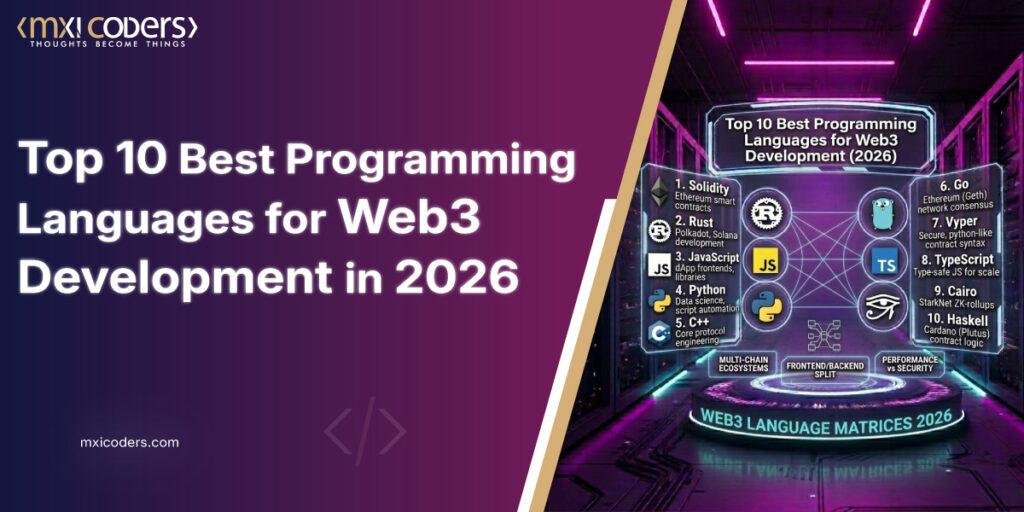
➤ Top 10 Best Programming Languages for Web3 Development

1. Solidity

Better to use Ethereum smart contracts.

Used in: DeFi, NFTs

Pros: High number of developers, great documentation, and an industry-standard for the Ethereum Virtual Machine (EVM).

Cons: Prone to some security issues when not well coded; expensive to run on Layer 1.

Used in: Uniswap (DEX), OpenSea (NFT Marketplace), and Aave (Lending).

2. Rust

Better to use: High-performance blockchains.

Used in: Solana, Polkadot

Security: Rust is known for its memory safety, which helps prevent common code bugs that cause crashes or hacks. It is constructed to be fast and in parallel.

Pros: very fast and effective; expanding non-EVM chain ecosystem.

Cons: Large learning curve upon entry compared to Solidity.

Used in: Solana smart contracts and the Substrate of Polkadot.

3. JavaScript

Better to use for: Web3 frontend

Used in: Web3.js, Ethers.js

Pros: It is The internet glue; it is familiar to all web developers. Vital in the development of the interface that the user interacts with.

Cons: Not utilized in writing the actual smart contracts (on most chains), only to interface with them.

Practical applications: Metamask integration and the frontends of nearly all dApps.

4. Python

Better use for: Prototyping, scripting.

Used in: Implementing costly going concern cases and automated trading bots.

Pros: It has an easy syntax and strong libraries (such as Brownie and Web3.py), which are ideal when it comes to testing and data mining.

Cons: Compared to compiled languages such as Rust or Go, is generally slower.

5. Go (Golang)

Better use for:  Blockchain infrastructure

Used in: Hyperledger Fabric and the implementation core of Ethereum (Geth).

Pros: Good when one has to work on several tasks simultaneously (concurrently). It supports most blockchain networks.

Cons: Not commonly applied to smart contracts at the application level.

6. C++

Better use for: Those who want to build a blockchain from the ground up.

Used in: The EOS network and the source code of Bitcoin.

Pros: It provides complete control over hardware resources; very high performance for resource-intensive jobs.

Cons: Widely complicated; a single malfunction will cause the whole network to fall.

7. TypeScript

Better use for: Scalable Web3 apps

Used in: Enterprise-scale frontends and SDKs of dApps.

 Pros: Provides type definitions for JavaScript, which helps prevent early detection of errors essential for handling financial transactions.

Cons: Before it can be operated in a browser, it must first be compiled.

8. Vyper

Better use for: The secure smart contracts is best suited.

Used in Curve Finance and several DAO governance modules.

Pros: A Python-like EVM language specifically designed to be lightweight and easy to audit to minimise the attack surface.

Cons: Smaller community and fewer features compared to Solidity.

9. Move

Better to use: Next-gen blockchain ecosystems.

Pros: It is the brainchild of the creators of Diem, of the same Meta; it considers digital assets as resources that can neither be copied nor destroyed.

Cons: Relatively new, which means that it has a smaller job market than Rust.

Used in: Aptos and Sui blockchains.

10. Cairo

Better to use ZK-based applications.

Pros: It was designed specifically to help create Zero-Knowledge (ZK) proofs, which enable massive scale and privacy on Ethereum.

Cons: The most expert-based; uses a dissimilar mental model to reason.

Used in: Starknet and high-frequency trading scaling.

➤ Which Web3 Programming Language Should You Learn?

Choosing your first or next language depends entirely on your current skills and your 2026 career goals. Use this quick guide to find the path that fits your background.

For Beginners

→ JavaScript + Solidity

If you are new to coding or coming from a standard web development background, start here. JavaScript allows you to build the “face” of the application that users actually see, while Solidity is the most beginner-friendly way to understand how smart contracts work. Because most Web3 resources focus on these two, you will find the most tutorials and community help.

For Backend Engineers

→ Go, Rust

Provided that you already have experience with server-side logic, system programming, or cloud infrastructure, these are the best bets. The development of actual blockchain networks and nodes is based on Go (Golang), and the high-performance environment of modern chains, non-EVM, is provided by Rust. These languages leverage your prior experience with memory management and concurrency.

For High-Paying Roles

→ Solidity, Rust

The very top in the space will be paid to write secure, audited code in 2026. Enterprise Ethereum and DeFi projects are always in need of Solidity experts. At the same time, high-speed networks such as Solana and Polkadot are eager to hire Rust programmers and often pay them well, given the language complexity and the criticality of the systems they develop.

➤ Future Trends in Web3 Programming Languages

The terrain of blockchain development in 2026 is shifting towards experimental coding and high-performance, specialized infrastructure. With this maturity, the industry is experiencing three major changes that shape the future of decentralised web writing by developers.

  •  Rise of Rust Ecosystems: Rust has now crossed the chasm from a niche systems language to the standard for high-performance blockchains. By 2026, it will be running the backbones of major networks such as Solana, Polkadot, and Near, as well as the new Modular Blockchain layers (such as Celestia). Its memory safety and fearless concurrency have now become essential to developers creating high-throughput applications that handle billions of assets.

  • Expansion of ZK Languages (Cairo): As Layer 2 scaling solutions have exploded, Zero-Knowledge (ZK) proofs have become a privacy and scaling necessity. This has given rise to the rapid growth of Cairo, the native language of Starknet. Compared to general-purpose languages, Cairo is particularly optimised for producing provable code and is the tool of choice for developers interested in ZK-Rollups and secure, off-chain computing.

  • Multi-Chain Development: It is the new age of one-blockchain constructions. 2026 is the year of Interoperability. Developers are increasingly using protocol-agnostic toolkits and app-chain models to enable a single codebase to interact with any one of several networks. The ability to master languages that support cross-chain standards, or tools that enable EVM and non-EVM ecosystems, is now the defining characteristic of a senior Web3 engineer.

➤ The Right Tool for the Right Chain

The search for the “best” Web3 programming language usually ends in a single realization: there is no universal winner. The decentralised space in 2026 is far too diverse to support a one-size-fits-all solution. Instead, the winner is determined by your specific mission.

Are you building a high-frequency trading platform? Rust is your best friend. Drafting a simple NFT drop on Ethereum? Solidity remains the undisputed king. Integrating a wallet into a sleek mobile interface? You can’t touch JavaScript.

In the high-velocity world of blockchain development trends, picking the wrong language isn’t just a minor setback; it’s a massive drain on your most valuable resources. Choosing an incompatible stack means losing precious time to refactoring, missing out on critical ecosystem grants, or worse, deploying code that isn’t optimized for the security demands of the modern web.

best programming languages for web3 development

The dream of a truly decentralized internet is no longer a “whitepaper-only” concept. As we move into 2026, Web3 has matured from a playground for experimental DeFi protocols into a robust infrastructure supporting real-world asset tokenisation, decentralised AI, and modular blockchain networks.

But here is the reality check: the “wild west” era of coding is over. Today’s Web3 ecosystem demands more than just clever logic; it requires uncompromising security, extreme scalability, and seamless interoperability. Whether you are building high-speed Layer 2 rollups, AI-driven smart contracts, or immersive metaverse experiences, your choice of stack is the most critical decision you’ll make.

In this guide, we’ve analyzed market demand, developer sentiment, and the shifting landscape of 2026 to bring you the definitive list of the top 10 programming languages you need to master to lead the next evolution of the web.

➤ What Are Web3 Programming Languages?

Web3 programming languages are specialized tools for building decentralised applications (dApps), securing smart contracts, and developing robust blockchain protocols. Unlike traditional programming languages, these languages prioritise security and decentralisation, enabling developers to create autonomous, transparent systems that manage digital assets and execute logic directly on distributed networks without central intermediaries.

 The Web3 Development Stack

To create a fully decentralized project, you tend to work on three separate layers:

  • Smart Contract Languages: These are specialized on-chain languages (such as Solidity or Rust) used to implement self-executing logic resident on the blockchain.
  • Backend Blockchain Interaction: These libraries and tools (e.g., Ethers.js or Web3.py) serve as the plumbing, enabling your server to communicate with the blockchain and access data.
  • Frontend Web3 Integration: This is where you build the user interface with conventional web frameworks (such as React or Next.js) and wallet providers to interact with and press the buttons and sign the transactions.

➤ Why Choosing the Right Web3 Language Matters

In a decentralized development environment, the choice of language is not only a syntax-preference issue; it is a business decision. Since Web3 code typically handles millions of dollars in digital assets, the stakes are considerably higher than in standard web apps. The correct choice of tool will help make your project safe, cost-effective to manage, and durable.

Key Factors to Consider

  • Security Risks: There is no such thing as law with Web3. One flaw of a smart contract may cause irreversible loss of money. The first defence against exploits is to use a language with good security and sophisticated auditing software.

  • Performance and Gas Efficiency: Each operation in a blockchain has a cost of gas. Certain languages are more execution-friendly, i.e., users incur lower transaction fees, which is a colossal competitive advantage to your dApp.

  • Ecosystem Support: Not all languages are applicable everywhere. Whether you are constructing an Ethereum (EVM) ecosystem, a Solana network running at high speeds, or a new modular chain, such as Celestia, currently depends on your decision. The employment sector is professionalized. Knowing a high-demand language such as Rust or Solidity can make you much more likely to earn more and get access to the most innovative labs in the field.

The employment sector is professionalized; knowing a high-demand language can make you much more likely to earn more. If you are looking to scale your project quickly, you may need to hire web3 developers who specialize in these specific high-performance stacks.

➤ Top 10 Best Programming Languages for Web3 Development

1. Solidity

Better to use Ethereum smart contracts.

Used in: DeFi, NFTs

Pros: High number of developers, great documentation, and an industry-standard for the Ethereum Virtual Machine (EVM).

Cons: Prone to some security issues when not well coded; expensive to run on Layer 1.

Used in: Uniswap (DEX), OpenSea (NFT Marketplace), and Aave (Lending).

2. Rust

Better to use: High-performance blockchains.

Used in: Solana, Polkadot

Security: Rust is known for its memory safety, which helps prevent common code bugs that cause crashes or hacks. It is constructed to be fast and in parallel.

Pros: very fast and effective; expanding non-EVM chain ecosystem.

Cons: Large learning curve upon entry compared to Solidity.

Used in: Solana smart contracts and the Substrate of Polkadot.

3. JavaScript

Better to use for: Web3 frontend

Used in: Web3.js, Ethers.js

Pros: It is The internet glue; it is familiar to all web developers. Vital in the development of the interface that the user interacts with.

Cons: Not utilized in writing the actual smart contracts (on most chains), only to interface with them.

Practical applications: Metamask integration and the frontends of nearly all dApps.

4. Python

Better use for: Prototyping, scripting.

Used in: Implementing costly going concern cases and automated trading bots.

Pros: It has an easy syntax and strong libraries (such as Brownie and Web3.py), which are ideal when it comes to testing and data mining.

Cons: Compared to compiled languages such as Rust or Go, is generally slower.

5. Go (Golang)

Better use for:  Blockchain infrastructure

Used in: Hyperledger Fabric and the implementation core of Ethereum (Geth).

Pros: Good when one has to work on several tasks simultaneously (concurrently). It supports most blockchain networks.

Cons: Not commonly applied to smart contracts at the application level.

6. C++

Better use for: Those who want to build a blockchain from the ground up.

Used in: The EOS network and the source code of Bitcoin.

Pros: It provides complete control over hardware resources; very high performance for resource-intensive jobs.

Cons: Widely complicated; a single malfunction will cause the whole network to fall.

7. TypeScript

Better use for: Scalable Web3 apps

Used in: Enterprise-scale frontends and SDKs of dApps.

 Pros: Provides type definitions for JavaScript, which helps prevent early detection of errors essential for handling financial transactions.

Cons: Before it can be operated in a browser, it must first be compiled.

8. Vyper

Better use for: The secure smart contracts is best suited.

Used in Curve Finance and several DAO governance modules.

Pros: A Python-like EVM language specifically designed to be lightweight and easy to audit to minimise the attack surface.

Cons: Smaller community and fewer features compared to Solidity.

9. Move

Better to use: Next-gen blockchain ecosystems.

Pros: It is the brainchild of the creators of Diem, of the same Meta; it considers digital assets as resources that can neither be copied nor destroyed.

Cons: Relatively new, which means that it has a smaller job market than Rust.

Used in: Aptos and Sui blockchains.

10. Cairo

Better to use ZK-based applications.

Pros: It was designed specifically to help create Zero-Knowledge (ZK) proofs, which enable massive scale and privacy on Ethereum.

Cons: The most expert-based; uses a dissimilar mental model to reason.

Used in: Starknet and high-frequency trading scaling.

➤ Which Web3 Programming Language Should You Learn?

Choosing your first or next language depends entirely on your current skills and your 2026 career goals. Use this quick guide to find the path that fits your background.

For Beginners

→ JavaScript + Solidity

If you are new to coding or coming from a standard web development background, start here. JavaScript allows you to build the “face” of the application that users actually see, while Solidity is the most beginner-friendly way to understand how smart contracts work. Because most Web3 resources focus on these two, you will find the most tutorials and community help.

For Backend Engineers

→ Go, Rust

Provided that you already have experience with server-side logic, system programming, or cloud infrastructure, these are the best bets. The development of actual blockchain networks and nodes is based on Go (Golang), and the high-performance environment of modern chains, non-EVM, is provided by Rust. These languages leverage your prior experience with memory management and concurrency.

For High-Paying Roles

→ Solidity, Rust

The very top in the space will be paid to write secure, audited code in 2026. Enterprise Ethereum and DeFi projects are always in need of Solidity experts. At the same time, high-speed networks such as Solana and Polkadot are eager to hire Rust programmers and often pay them well, given the language complexity and the criticality of the systems they develop.

➤ Future Trends in Web3 Programming Languages

The terrain of blockchain development in 2026 is shifting towards experimental coding and high-performance, specialized infrastructure. With this maturity, the industry is experiencing three major changes that shape the future of decentralised web writing by developers.

  •  Rise of Rust Ecosystems: Rust has now crossed the chasm from a niche systems language to the standard for high-performance blockchains. By 2026, it will be running the backbones of major networks such as Solana, Polkadot, and Near, as well as the new Modular Blockchain layers (such as Celestia). Its memory safety and fearless concurrency have now become essential to developers creating high-throughput applications that handle billions of assets.

  • Expansion of ZK Languages (Cairo): As Layer 2 scaling solutions have exploded, Zero-Knowledge (ZK) proofs have become a privacy and scaling necessity. This has given rise to the rapid growth of Cairo, the native language of Starknet. Compared to general-purpose languages, Cairo is particularly optimised for producing provable code and is the tool of choice for developers interested in ZK-Rollups and secure, off-chain computing.

  • Multi-Chain Development: It is the new age of one-blockchain constructions. 2026 is the year of Interoperability. Developers are increasingly using protocol-agnostic toolkits and app-chain models to enable a single codebase to interact with any one of several networks. The ability to master languages that support cross-chain standards, or tools that enable EVM and non-EVM ecosystems, is now the defining characteristic of a senior Web3 engineer.

➤ The Right Tool for the Right Chain

The search for the “best” Web3 programming language usually ends in a single realization: there is no universal winner. The decentralised space in 2026 is far too diverse to support a one-size-fits-all solution. Instead, the winner is determined by your specific mission.

Are you building a high-frequency trading platform? Rust is your best friend. Drafting a simple NFT drop on Ethereum? Solidity remains the undisputed king. Integrating a wallet into a sleek mobile interface? You can’t touch JavaScript.

In the high-velocity world of blockchain development trends, picking the wrong language isn’t just a minor setback; it’s a massive drain on your most valuable resources. Choosing an incompatible stack means losing precious time to refactoring, missing out on critical ecosystem grants, or worse, deploying code that isn’t optimized for the security demands of the modern web.

Ready to transform your business with smart software solutions?

Harness the power of custom software development to streamline operations, reduce costs, and boost efficiency. Start by exploring cutting-edge approaches like cloud-native platforms, API-first architecture, and AI-driven automation to future-proof your systems and stay ahead of the competition.

Book free consultation

Let’s build your idea together and serve society.

Author

Ashok Rathod

Tech Consultant

Experience
25 Years
Growth Architect for Startups & SMEs | Blockchain, AI , MVP Development, & Data-Driven Marketing Expert.

Transform the Carbon Credit Industry

Build a Transparent, Scalable Carbon Credit Marketplace with Blockchain.