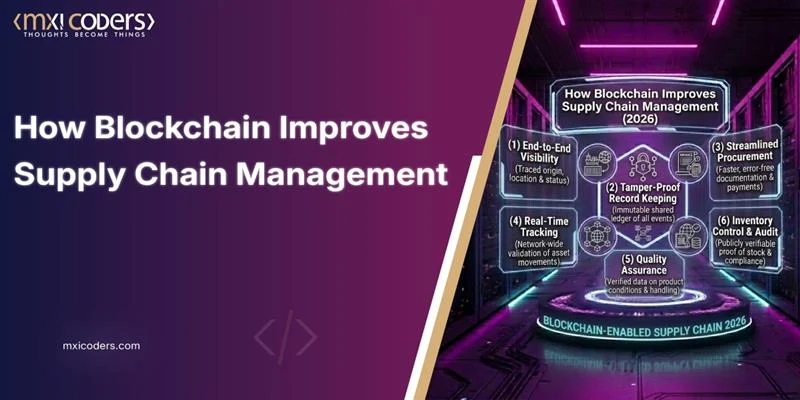
Global supply chains still run on fragmented systems, manual paperwork, and delayed data sharing. This lack of transparency creates disputes, inefficiencies, and costly delays.
Blockchain changes this by creating a shared, tamper-proof ledger where every transaction, shipment update, and condition check is recorded in real time. For example, a product like a mango can be tracked from farm to store within seconds, with every step verified and visible to all stakeholders.
This level of traceability eliminates disputes, reduces fraud, and improves coordination across the supply chain.
To understand why this shift matters, it’s important to first look at the core problems in today’s supply chain systems.
The Core Problems in Modern Supply Chains
Absence of Transparency: There is a tendency for data to be locked in silos among various manufacturers, shippers, and retailers. In situations where information is not shared in real time, it is almost impossible to trace a product’s journey or anticipate delays.
Paperwork: A lot of world trade is still based on paper-based trade. This poses a very high risk of human error and has agonizingly sluggish processing time, particularly when dealing with complex customs and port logistics.
Counterfeit Goods: It is extremely hard to establish the provenance (provenance) of high-value items such as luxury goods, lifesaving drugs or organic food due to the lack of a digital paper trail, which causes trust problems and safety concerns.
Delayed Payments: In traditional finance, time is faster than that of cargo. The international partners can also take a lot of time before the invoice is reconciled, which holds up the capital, and this leads to unnecessary strain between the suppliers and the buyers.
Ways Blockchain Transforms Supply Chain Logistics
These four technical pillars will form the basis of understanding the how-to of blockchain integration. They all deal with one of the flaws of traditional logistics and transform the uncontrolled stream of goods into a digital picture.
A. End-to-End Traceability and Provenance
With a conventional supply chain, after a product is out of the factory, it tends to become the black hole of information. Blockchain transforms this by establishing an unchangeable digital record of all physical things in a digital trail.
Digital Birth Certificates: A product is given a special digital identity at the moment of its creation. This “birth certificate” is posted in the blockchain using RFID tags or QR codes, and the physical object is attached to the electronic file.
Chain of Custody: With each exchange of hands, manufacturer, shipper, or retailer,
the occurrence is added to the ledger automatically. The decentralization of
the ledger space means that no one party can update the history by revisiting it.
Consumer Trust: This technology gives the consumer the power back. All that a customer needs to do is scan a code on a package of coffee or a luxurious handbag to ensure they know everything that has happened to it..
B. Smart Contracts to Automate Workflow
Smart contracts are self-executing contracts that automatically execute once certain events in the real world happen.
Instant Payments: Payments are automatically discharged to one of the carriers when it
It is verified that the shipment has reached the destination based on a GPS location.
Compliance Checks: A shipment is locked until all the required safety certifications and customs forms are digitally uploaded and verified.
Minimum Controversies: Since the code is in writing, there is no need to have any third party
party mediation and protracted negotiations concerning the execution of the contract.
C. Improved Security and Prevention of Fraud
The decentralization introduced by blockchain makes it almost impossible that any one party will intentionally cook the books and conceal their mistakes.
NonModifiable Records: Once a cargo weight or shipping temperature is recorded, it
cannot be changed. This will prevent the damage that can be concealed or the theft in transit.
Authorized Access: Sensitive business information is secured, such that only the authorized partners would be able to read particular data and still have a common, transparent history.
Anti-Counterfeiting: Valuable goods such as life-saving drugs or luxurious electronics are checked in real-time, and it is impossible to introduce any fakes in the legitimate supply chain.
D. Optimization of Inventory and Warehouse
Blockchain ensures leaner operations and a colossal waste reduction due to the provision of one source of truth.
Live Inventory Tracking: Once all warehouses are in sync, businesses can remove ghost inventory (products that are not on the shelf but still appear on paper). It is also possible to have predictive Logistics, where clean, real-time data enables AI tools and LLMs to accurately estimate future bottlenecks before they occur, ensuring the supply chain continues to run efficiently. Many enterprises seeking to implement these systems look to Blockchain development services to bridge the gap between their current warehouse tech and the ledger.
Also Read: The Future of Blockchain in Finance: Key Predictions for 2030
Real-World Use Cases for Blockchain in Supply Chain
In order to get an idea of how these technical pillars operate in reality, we can consider particular industries where blockchain is already addressing the important safety and ethical issues. The following examples give the social proof that indicates that the technology is no longer in the theory phase but is rapidly transforming into an enormous influence on the world.
Food Safety: The ability to trace leafy greens back to the farm to the grocery store is able to enable retailers to recall contamination within seconds instead of weeks. Blockchain can identify the specific versions of the batch and farm, thus avoiding the loss of safe food and safeguarding human health in case of a recall.
Pharmaceuticals: With blockchain, fake drugs do not reach the legitimate drug supply network as serial codes are checked each time a particular drug passes any one of the stops. This makes the lifesaving drugs original and ensures they have not undergone any tampering or substitution with dangerous counterfeits along the way.
Ethical Sourcing: Businesses are now able to demonstrate the fact that diamonds or cobalt are a peaceable commodity by tracing it all the way back to the mine to the jeweller. This digital registry will offer an open book on the provenance of a gem, meaning that the goods you purchase will be of high ethical and human rights standards.
Cold Chain Monitoring: Vaccines or frozen goods shipped via IoT sensors and blockchain can be verified by the logistics team to have remained within a certain temperature range during transit. When a shipment becomes too warm, the sensor will automatically note it on the blockchain immediately, which notifies the receiver about it before the use of the product.
Combination of IoT and Blockchain
The combination of both physical hardware and digital ledgers is the real strength of a modern supply chain. Internet of Things (IoT) sensors combined with blockchain technology will enable companies to bridge the gap between what is being recorded in the office and what is going on in the warehouse.
The Integration of IoT and Blockchain
Real-Time Tracking: IoT devices are high-tech and provide essential information, including temperature, humidity, and accuracy of GPS position, to the blockchain. This builds a record of the health of a shipment in real-time, making it unchangeable, and so sensitive items such as vaccines or fresh produce do not leave the atmosphere that they need.
Autonomous Documentation: One of the most challenging problems in logistics is human error. By using the machine to record their status in the ledger, you remove the human factor. Should a container be opened or a pallet be dropped, this hardware will automatically capture the incident, and the accuracy of the reporting will be 100 percent.
Predictive Logistics: Since IoT data is free of impurities, time-stamped, and cannot be altered, it forms the ideal basis of state-of-the-art AI tools. This data can be used by companies to run simulations in which they predict and avoid any future bottlenecks before they happen. Businesses often Hire blockchain developer specialists to integrate these IoT sensors directly into the smart contract architecture.
Conclusion: Building a Resilient, Circular Economy
Blockchain has grown far beyond its origins as just a “crypto” tool; it is becoming the essential backbone of a new era in global trade. By shifting toward a decentralized model, we are moving away from closed-door systems and toward a future where businesses can build supply chains
that are truly ethical and transparent. This technology makes it possible to track every product back to its source, ensuring that “circular” isn’t just a buzzword but a measurable reality. Ultimately, this isn’t just about better data it’s about restoring trust in the things we buy and creating a more resilient, honest economy that works for everyone.