Blockchain

Does Amazon Use Blockchain? Everything You Need to Know

Ashok Rathod

Tech Consultant

Posted on
8th Oct 2024
7 min
Read
Share

Table of Contents

  • Quick Tips
  • Familiarize yourself with Cash App
  • Enable two-factor authentication
  • Utilize the optional Cash App
  • Conclusion

Blockchain is no longer just a crypto buzzword. Banks, hospitals, shipping companies, and retailers are all exploring how to use it for real business problems. And as more enterprises move in this direction, one question keeps coming up: does Amazon use blockchain?

It is a fair question. Amazon runs the world’s largest cloud platform, sits at the center of global e-commerce, and has a history of jumping into new technologies early. So where does blockchain fit into that picture?

The numbers show why this matters. The global blockchain market was valued at $17.57 billion in 2023 and is expected to grow at a CAGR of 87.7% through 2030. Gartner estimates blockchain will create $3.1 trillion in business value by the end of this decade. Enterprises are not dabbling anymore they are committing serious resources.

➤ Does Amazon Use Blockchain?

Yes, Amazon does use blockchain mainly through AWS. But Amazon is not a blockchain company the way Bitcoin or Ethereum are. It did not build its business on a distributed ledger. What Amazon did is recognize that its enterprise customers needed blockchain tools, so it built them.

The more useful way to think about it: Amazon is a major provider of blockchain infrastructure, not a blockchain-native business.

➥ Amazon’s Approach to Blockchain Technology

Amazon’s approach is very practical. Instead of launching its own cryptocurrency or joining a public blockchain network, Amazon focused on giving businesses the cloud tools they need to build and run blockchain applications themselves.

This fits naturally into what AWS already does. AWS does not tell you what to build it just gives you reliable infrastructure to build on. Blockchain services work the same way. Amazon provides the backend, businesses build the products, and everyone gets what they need.

➥ Why Amazon Invested in Blockchain

A few clear reasons drove this investment. Enterprise customers were asking for it companies in finance, logistics, and healthcare wanted blockchain tools they could actually deploy without building everything from scratch. Supply chain transparency was a big one too; businesses wanted tamper-proof tracking systems that multiple parties could trust. Secure data-sharing between organizations that do not fully trust each other is another problem blockchain handles well. And the growth of decentralized applications created demand for reliable hosting infrastructure.

Amazon saw the demand and built the tools to serve it.

➤ What Is Amazon Managed Blockchain?

➥ Amazon Managed Blockchain Definition

Amazon Managed Blockchain is a fully managed AWS service that helps businesses create and run their own blockchain networks. The “managed” part means Amazon handles the heavy infrastructure work setting up nodes, managing certificates, monitoring performance so businesses can focus on building their actual applications.

It launched in 2019 and has become a go-to option for companies that want enterprise blockchain without the headache of maintaining everything themselves.

➥ How Amazon Managed Blockchain Works

Running a blockchain network from scratch is complicated. You need to configure servers, set up peer nodes, manage cryptographic certificates, handle upgrades, and keep an eye on performance and that is before you have written a single line of your actual application.

Amazon Managed Blockchain takes most of that off your plate. It handles node management automatically, scales the network as your transaction volume grows, and connects naturally to the rest of the AWS ecosystem. A company that might have spent months setting up blockchain infrastructure can now get running in days.

➥ Supported Blockchain Frameworks

The service supports two main frameworks. Hyperledger Fabric is the primary one it is designed for enterprise use cases where participants are known and you want controlled access to the network. Ethereum support is also available for businesses that need to interact with public blockchain networks or deploy smart contracts.

➥ Key Features of Amazon Managed Blockchain

Security is built on AWS’s existing infrastructure encryption, identity management, and audit logging all come standard. The service scales automatically based on demand, so you are not over-provisioning or scrambling when load increases. CloudWatch integration gives you real-time visibility into what is happening on the network. And because it sits inside AWS, it works smoothly alongside services like S3, Lambda, and AWS QLDB.

Also Read: The Future of Blockchain in Finance: Key Predictions for 2030

➤ How Amazon Uses Blockchain Technology

➥ Blockchain Through AWS Services

Amazon’s primary blockchain role is as a cloud-based infrastructure provider. Businesses across dozens of industries use AWS to host their blockchain networks rather than running their own physical servers. This enterprise blockchain hosting model means companies get production-grade infrastructure without needing a dedicated team to maintain it.

➥ Supply Chain and Logistics Applications

Supply chain is probably the most active use case for AWS blockchain customers, and it is easy to see why. When multiple companies manufacturers, shippers, retailers, regulators all need to see the same product data, a shared blockchain record is far more trustworthy than one company’s spreadsheet.

Product tracking systems built on blockchain create a permanent record of where something has been and what happened to it along the way. No one can quietly edit that history. For industries like food safety, pharmaceuticals, and luxury goods, that kind of verifiable transparency is not just useful it is increasingly expected.

➥ Smart Contract Hosting

Amazon’s Ethereum support makes it possible to host smart contract-based applications on AWS. Understanding smart contract working is useful here, smart contracts are programs that live on the blockchain and run automatically when certain conditions are met. No one has to manually approve or trigger the action. It just executes.

AWS gives businesses the infrastructure to deploy and run these contracts at scale, which makes it a practical option for automated settlement systems, digital asset platforms, and other decentralized applications that need enterprise-grade reliability.

➥ Data Security and Verification

Some industries need records that simply cannot be changed after the fact, audit logs, clinical trial data, financial transactions, legal agreements. Blockchain handles this naturally. Once something is written to the ledger, it stays there. Multiple parties hold identical copies, and any discrepancy is immediately visible.

AWS makes it straightforward for enterprises to implement this kind of immutable record-keeping without building a custom system from the ground up. For regulated industries, that combination of permanence, transparency, and shared access solves real compliance problems.

➤ Does Amazon Use Cryptocurrency?

➥ Amazon and Bitcoin Payments

Amazon does not accept Bitcoin or most other cryptocurrencies directly at checkout. You cannot pay for your order on Amazon.com with Ethereum or any other digital currency through an official Amazon payment option. There are workarounds involving gift cards and third-party services, but none of those are Amazon’s own products.

This surprises some people, given how deep Amazon’s blockchain involvement is on the AWS side.

➥ Amazon’s Position on Crypto

Amazon’s position is not really contradictory once you understand the distinction. Blockchain as infrastructure technology reliable, useful, already solving real business problems is something Amazon is very comfortable with. Cryptocurrency as a consumer payment method is a different matter entirely. It brings volatility, regulatory uncertainty, and user friction that do not benefit Amazon’s retail operation.

So Amazon holds both positions simultaneously: deeply involved in blockchain infrastructure, largely absent from consumer crypto.

➥ Rumors About Amazon Launching a Cryptocurrency

Speculation about an Amazon cryptocurrency surfaces regularly. Some of it is driven by real signals Amazon has posted job listings related to digital currencies and has shown interest in how central bank digital currencies might develop. But as of now, there is no official Amazon crypto token. The rumors consistently run ahead of reality. What Amazon has actually done is invest steadily in blockchain infrastructure, which is a different thing entirely.

➤ Conclusion

Amazon is not a blockchain company in the traditional sense, but it is one of the most significant players in enterprise blockchain infrastructure. Through Amazon Managed Blockchain and the broader AWS platform, it gives businesses a reliable way to build and run blockchain networks without managing the underlying complexity themselves.

As blockchain development trends continue shifting toward real operational use cases supply chain tracking, secure data sharing, automated contracts, AWS is well positioned as the infrastructure layer underneath it all. Custom enterprise blockchain development on platforms like AWS is already standard practice in many industries, and that is only growing.

Amazon may not let you pay with Bitcoin at checkout. But if a company somewhere is running a blockchain network that tracks your package, verifies a pharmaceutical shipment, or settles a financial transaction there is a solid chance it is running on Amazon’s infrastructure.
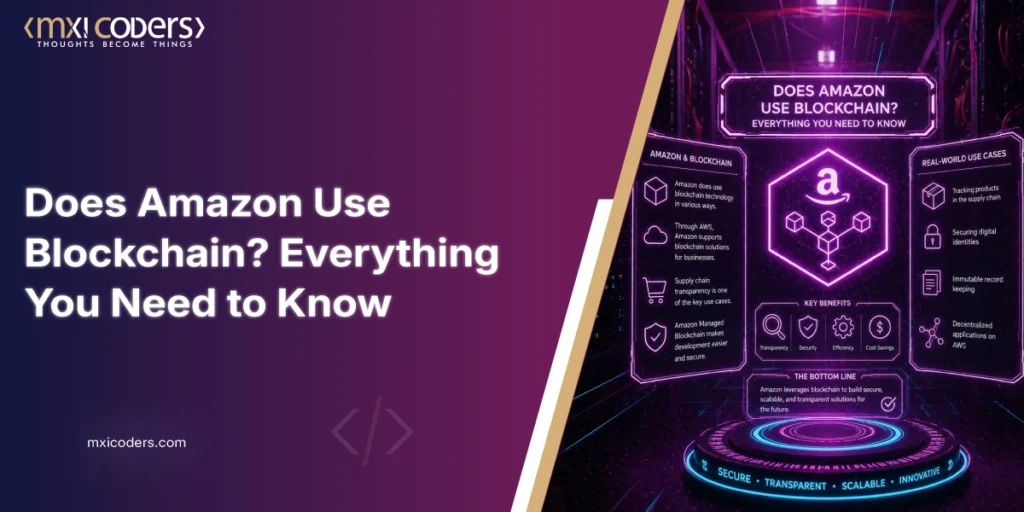

does amazon use blockchain everything you need to know

Blockchain is no longer just a crypto buzzword. Banks, hospitals, shipping companies, and retailers are all exploring how to use it for real business problems. And as more enterprises move in this direction, one question keeps coming up: does Amazon use blockchain?

It is a fair question. Amazon runs the world’s largest cloud platform, sits at the center of global e-commerce, and has a history of jumping into new technologies early. So where does blockchain fit into that picture?

The numbers show why this matters. The global blockchain market was valued at $17.57 billion in 2023 and is expected to grow at a CAGR of 87.7% through 2030. Gartner estimates blockchain will create $3.1 trillion in business value by the end of this decade. Enterprises are not dabbling anymore they are committing serious resources.

➤ Does Amazon Use Blockchain?

Yes, Amazon does use blockchain mainly through AWS. But Amazon is not a blockchain company the way Bitcoin or Ethereum are. It did not build its business on a distributed ledger. What Amazon did is recognize that its enterprise customers needed blockchain tools, so it built them.

The more useful way to think about it: Amazon is a major provider of blockchain infrastructure, not a blockchain-native business.

➥ Amazon’s Approach to Blockchain Technology

Amazon’s approach is very practical. Instead of launching its own cryptocurrency or joining a public blockchain network, Amazon focused on giving businesses the cloud tools they need to build and run blockchain applications themselves.

This fits naturally into what AWS already does. AWS does not tell you what to build it just gives you reliable infrastructure to build on. Blockchain services work the same way. Amazon provides the backend, businesses build the products, and everyone gets what they need.

➥ Why Amazon Invested in Blockchain

A few clear reasons drove this investment. Enterprise customers were asking for it companies in finance, logistics, and healthcare wanted blockchain tools they could actually deploy without building everything from scratch. Supply chain transparency was a big one too; businesses wanted tamper-proof tracking systems that multiple parties could trust. Secure data-sharing between organizations that do not fully trust each other is another problem blockchain handles well. And the growth of decentralized applications created demand for reliable hosting infrastructure.

Amazon saw the demand and built the tools to serve it.

➤ What Is Amazon Managed Blockchain?

➥ Amazon Managed Blockchain Definition

Amazon Managed Blockchain is a fully managed AWS service that helps businesses create and run their own blockchain networks. The “managed” part means Amazon handles the heavy infrastructure work setting up nodes, managing certificates, monitoring performance so businesses can focus on building their actual applications.

It launched in 2019 and has become a go-to option for companies that want enterprise blockchain without the headache of maintaining everything themselves.

➥ How Amazon Managed Blockchain Works

Running a blockchain network from scratch is complicated. You need to configure servers, set up peer nodes, manage cryptographic certificates, handle upgrades, and keep an eye on performance and that is before you have written a single line of your actual application.

Amazon Managed Blockchain takes most of that off your plate. It handles node management automatically, scales the network as your transaction volume grows, and connects naturally to the rest of the AWS ecosystem. A company that might have spent months setting up blockchain infrastructure can now get running in days.

➥ Supported Blockchain Frameworks

The service supports two main frameworks. Hyperledger Fabric is the primary one it is designed for enterprise use cases where participants are known and you want controlled access to the network. Ethereum support is also available for businesses that need to interact with public blockchain networks or deploy smart contracts.

➥ Key Features of Amazon Managed Blockchain

Security is built on AWS’s existing infrastructure encryption, identity management, and audit logging all come standard. The service scales automatically based on demand, so you are not over-provisioning or scrambling when load increases. CloudWatch integration gives you real-time visibility into what is happening on the network. And because it sits inside AWS, it works smoothly alongside services like S3, Lambda, and AWS QLDB.

Also Read: The Future of Blockchain in Finance: Key Predictions for 2030

➤ How Amazon Uses Blockchain Technology

➥ Blockchain Through AWS Services

Amazon’s primary blockchain role is as a cloud-based infrastructure provider. Businesses across dozens of industries use AWS to host their blockchain networks rather than running their own physical servers. This enterprise blockchain hosting model means companies get production-grade infrastructure without needing a dedicated team to maintain it.

➥ Supply Chain and Logistics Applications

Supply chain is probably the most active use case for AWS blockchain customers, and it is easy to see why. When multiple companies manufacturers, shippers, retailers, regulators all need to see the same product data, a shared blockchain record is far more trustworthy than one company’s spreadsheet.

Product tracking systems built on blockchain create a permanent record of where something has been and what happened to it along the way. No one can quietly edit that history. For industries like food safety, pharmaceuticals, and luxury goods, that kind of verifiable transparency is not just useful it is increasingly expected.

➥ Smart Contract Hosting

Amazon’s Ethereum support makes it possible to host smart contract-based applications on AWS. Understanding smart contract working is useful here, smart contracts are programs that live on the blockchain and run automatically when certain conditions are met. No one has to manually approve or trigger the action. It just executes.

AWS gives businesses the infrastructure to deploy and run these contracts at scale, which makes it a practical option for automated settlement systems, digital asset platforms, and other decentralized applications that need enterprise-grade reliability.

➥ Data Security and Verification

Some industries need records that simply cannot be changed after the fact, audit logs, clinical trial data, financial transactions, legal agreements. Blockchain handles this naturally. Once something is written to the ledger, it stays there. Multiple parties hold identical copies, and any discrepancy is immediately visible.

AWS makes it straightforward for enterprises to implement this kind of immutable record-keeping without building a custom system from the ground up. For regulated industries, that combination of permanence, transparency, and shared access solves real compliance problems.

➤ Does Amazon Use Cryptocurrency?

➥ Amazon and Bitcoin Payments

Amazon does not accept Bitcoin or most other cryptocurrencies directly at checkout. You cannot pay for your order on Amazon.com with Ethereum or any other digital currency through an official Amazon payment option. There are workarounds involving gift cards and third-party services, but none of those are Amazon’s own products.

This surprises some people, given how deep Amazon’s blockchain involvement is on the AWS side.

➥ Amazon’s Position on Crypto

Amazon’s position is not really contradictory once you understand the distinction. Blockchain as infrastructure technology reliable, useful, already solving real business problems is something Amazon is very comfortable with. Cryptocurrency as a consumer payment method is a different matter entirely. It brings volatility, regulatory uncertainty, and user friction that do not benefit Amazon’s retail operation.

So Amazon holds both positions simultaneously: deeply involved in blockchain infrastructure, largely absent from consumer crypto.

➥ Rumors About Amazon Launching a Cryptocurrency

Speculation about an Amazon cryptocurrency surfaces regularly. Some of it is driven by real signals Amazon has posted job listings related to digital currencies and has shown interest in how central bank digital currencies might develop. But as of now, there is no official Amazon crypto token. The rumors consistently run ahead of reality. What Amazon has actually done is invest steadily in blockchain infrastructure, which is a different thing entirely.

➤ Conclusion

Amazon is not a blockchain company in the traditional sense, but it is one of the most significant players in enterprise blockchain infrastructure. Through Amazon Managed Blockchain and the broader AWS platform, it gives businesses a reliable way to build and run blockchain networks without managing the underlying complexity themselves.

As blockchain development trends continue shifting toward real operational use cases supply chain tracking, secure data sharing, automated contracts, AWS is well positioned as the infrastructure layer underneath it all. Custom enterprise blockchain development on platforms like AWS is already standard practice in many industries, and that is only growing.

Amazon may not let you pay with Bitcoin at checkout. But if a company somewhere is running a blockchain network that tracks your package, verifies a pharmaceutical shipment, or settles a financial transaction there is a solid chance it is running on Amazon’s infrastructure.

Ready to transform your business with smart software solutions?

Harness the power of custom software development to streamline operations, reduce costs, and boost efficiency. Start by exploring cutting-edge approaches like cloud-native platforms, API-first architecture, and AI-driven automation to future-proof your systems and stay ahead of the competition.

Book free consultation

Let’s build your idea together and serve society.

Author

Ashok Rathod

Tech Consultant

Experience
25 Years
Growth Architect for Startups & SMEs | Blockchain, AI , MVP Development, & Data-Driven Marketing Expert.

Transform the Carbon Credit Industry

Build a Transparent, Scalable Carbon Credit Marketplace with Blockchain.

Index