Blockchain is one of the most talked-about technologies of the decade and for good reason. But being revolutionary doesn’t make it universally applicable. Businesses rushing into adoption and developers building on unproven stacks often discover the hard way that this technology comes with serious trade-offs. In fact, Gartner found that over 90% of enterprise blockchain projects stall or fail to reach full production, a number that should give any decision-maker pause. Whether you’re evaluating it for your enterprise or exploring dApp development for a new product, understanding the limitations upfront can save you time, money, and credibility. Here are the real limitations you should know before adopting it.
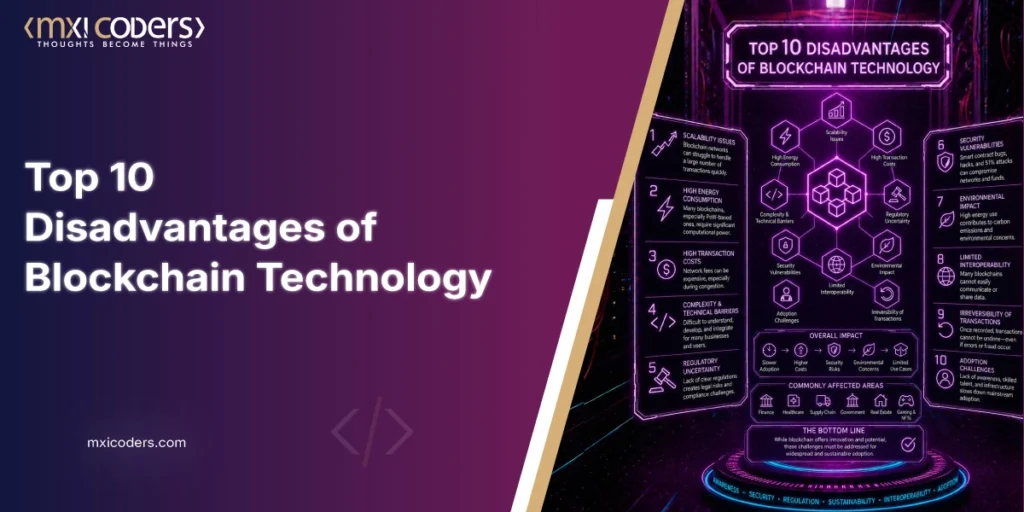
➤ Top 10 Major Limitations of Blockchain Technology
➥ 1. Scalability Issues
Blockchain networks process transactions far slower than centralized systems. Bitcoin handles roughly 7 transactions per second compared to Visa’s thousands. During periods of peak activity, networks become congested, causing delays and fee spikes. For enterprises expecting high throughput, this performance gap remains a fundamental barrier to wide-scale adoption.
➥ 2. High Energy Consumption
Proof of Work blockchains like Bitcoin consume enormous amounts of electricity to validate transactions. This has become a growing ESG concern for enterprises that have sustainability commitments and public accountability. The backlash is real. Companies face investor and stakeholder pressure to avoid energy-intensive infrastructure, pushing many toward greener consensus mechanisms.
➥ 3. Immutability vs. Data Privacy
One of blockchain’s greatest strengths and its permanence becomes a liability under modern data protection laws. Regulations like GDPR grant individuals the “right to erasure,” which directly conflicts with the design of an immutable ledger. Storing personally identifiable information on-chain creates compliance exposure that legal teams won’t easily approve, making careful architecture decisions essential from day one.
➥ 4. High Implementation Cost
Building on blockchain is expensive. Infrastructure setup, node management, audits, and custom enterprise blockchain development all carry premium price tags. Skilled blockchain engineers command salaries well above average software developers. For SMEs and early-stage startups, these costs can make blockchain adoption financially impractical without a clear and immediate ROI.
➥ 5. Steep Learning Curve
Blockchain architecture i.e from consensus mechanisms to cryptographic hashing to token standards and is genuinely complex. There’s a significant shortage of skilled professionals who understand it well enough to build production-grade systems. Organizations that attempt internal adoption often underestimate the training requirements, leading to slow rollouts and costly mistakes that could have been avoided with better preparation.
➥ 6. Regulatory Uncertainty
There is no unified global standard for blockchain regulation. Businesses operating across jurisdictions face conflicting AML and KYC compliance requirements, with rules that vary dramatically by country and continue to shift. This regulatory ambiguity creates ongoing legal risk and makes long-term planning difficult particularly for financial products and token-based business models.
➥ 7. Interoperability Problems
Most blockchain networks operate in isolation. Ethereum, Solana, Hyperledger, and others don’t natively communicate with each other, creating a fragmented ecosystem where data and assets are siloed. Cross-chain integration is technically demanding and often incomplete. For enterprises managing multi-vendor environments, this lack of interoperability significantly undermines the efficiency gains blockchain is supposed to deliver.
➥ 8. Security Vulnerabilities
Blockchain is often marketed as inherently secure, but this is an oversimplification. Smaller networks are vulnerable to 51% attacks, where a majority of mining power can be captured to manipulate the ledger. Smart contracts are the backbone of Ethereum development, which have been exploited repeatedly due to coding bugs. Human error, phishing attacks, and poor key management introduce additional risks that no protocol design can fully eliminate.
➥ 9. Data Storage Inefficiency
Every participating node stores a full copy of the entire blockchain. As transaction history grows, so does the storage burden on every node in the network. This bloat increases hardware requirements and long-term maintenance costs. For applications expecting large data volumes, this architectural constraint becomes a meaningful operational expense that compounds over time.
➥ 10. Governance & Hard Fork Risks
Decentralized decision-making is slow and often contentious. When the community disagrees on protocol changes, the result can be a hard fork, a permanent split in the network. For businesses that have built on top of a protocol, forks introduce uncertainty about which chain to follow, can disrupt operations, and require urgent technical responses that weren’t budgeted for.
Also Read: What Is Blockchain Development? A Complete Beginner’s Guide
➤ Real-World Blockchain Failure Examples
➥ The DAO Hack (2016)
A vulnerability in a smart contract allowed an attacker to drain approximately $60 million worth of Ether from The DAO investment fund is one of the earliest large-scale dApp in blockchain history. The exploit exposed how even thoroughly reviewed on-chain code can contain critical flaws, and that once funds are gone, recovery requires controversial intervention like a hard fork.
➥ Bitcoin’s Energy Crisis Backlash
In 2021, Tesla reversed its decision to accept Bitcoin as payment, citing the environmental impact of Proof of Work mining. The reversal was a high-profile signal that PoW’s energy demands are a genuine business risk not just a theoretical concern especially for companies with ESG commitments under scrutiny.
➥ Walmart’s Blockchain Supply Chain Slowdown
Walmart’s early blockchain pilot for supply chain tracking faced significant friction when integrating with existing legacy systems. The real cost of implementation exceeded initial projections, and the pace of adoption lagged behind expectations, a common pattern when organizations underestimate integration complexity.
➤ Industries Most Affected by These Disadvantages
These limitations don’t hit all sectors equally. Some industries carry disproportionate risk:
Finance & Banking: Regulatory uncertainty combined with scalability constraints continues to slow real-world DeFi adoption at the institutional level.
Healthcare: Immutability conflicts directly with HIPAA and GDPR requirements, making compliant on-chain storage of patient data a legal minefield.
Supply Chain & Logistics: High integration costs with legacy infrastructure, combined with storage inefficiency at scale, undermine the business case for many operators.
Government & Public Records: Governance challenges and the absence of global standards have stalled most public sector pilots before they reach meaningful deployment.
➤ When Should You NOT Use Blockchain?
Before committing resources, ask yourself these three questions:
- You control all the data yourself. A private database will be faster, cheaper, and easier to maintain.
- You need quick read/write transactions; traditional centralized systems outperform blockchain here without exception.
- Your problem doesn’t require decentralization or trustless verification adding blockchain won’t solve it, it will complicate it.
➤ Conclusion
Blockchain is a powerful tool but only when applied to the right problem. Ignoring its real limitations doesn’t make them disappear; it just makes them more expensive to discover later. The smartest adoption decisions start with knowing the limitations.
Need help evaluating whether blockchain is the right fit for your business? Talk to our team before you build.