[ Your Headline ] [ Highlight Word ]

[ One or two lines describing the offer — e.g. "Experience our services with a FREE 30-minute consultation." ]

[ Optional second line, e.g. "Have a concept in mind? Let's brainstorm together!" ]

Google ★★★★★ 4.8
GoodFirms ★★★★★ 4.7
Clutch ★★★★★ 5.0
Digital Marketing

What Are SEO Services? A Complete Guide to What's Included and How It Works

Ashok Rathod

Tech Consultant

Posted on
8th Jul 2026
7 min
Read
Share

Table of Contents

  • Quick Tips
  • Familiarize yourself with Cash App
  • Enable two-factor authentication
  • Utilize the optional Cash App
  • Conclusion

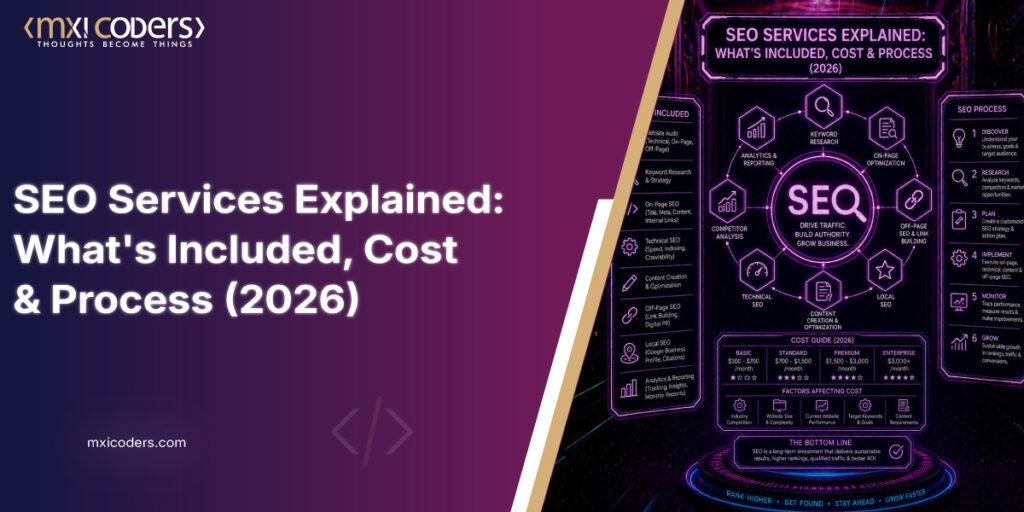
SEO services are a paid package of on page, off page, and technical work aimed at getting a website to rank higher in unpaid search results. A typical package combines keyword research, content optimization, link building services, and ongoing technical audits, and most providers price it as a monthly retainer rather than a one time project.

➤ How big is the SEO services industry right now?

The global market for SEO services is valued at roughly $83.98 billion in 2026, growing at a 12.12% compound annual rate, according to Mordor Intelligence’s 2026 SEO Services Market Report. On page SEO work alone made up about 41.8% of that revenue in 2025, and small and medium businesses account for close to 58% of total spend, which tells you this isn’t a niche service reserved for large enterprises. It also means the market is crowded, so a provider’s process and reporting matter as much as their pitch.

➤ What does a full SEO services package usually include?

Most agencies bundle four to five workstreams into a single retainer. Here’s how the core pieces compare:

ServiceMechanismBest FitTrade-off
Keyword researchMaps real search terms and intent to content topics before anything gets writtenAny business starting from scratch or entering a new marketOngoing work; search behavior shifts as AI-assisted search grows
On-page SEOOptimizes titles, headings, and content structure on pages you already controlSites with existing content that underperformsLimited ceiling on its own without off-page support
Link building servicesEarns or builds inbound links from other credible sitesCompetitive keywords where authority is the bottleneckSlower and typically the most expensive line item
Local SEO servicesOptimizes Google Business Profiles, citations, and review signalsBrick and mortar or service area businessesDoesn’t help national or global visibility
Technical SEOFixes crawlability, site speed, and structured dataLarger or older sites with accumulated technical debtRequires developer access and coordination

➤ Why does keyword research still come first?

Keyword research is the step that decides which searches you’re even trying to win, and skipping it is why a lot of content sits on page four of Google. Long tail queries make up roughly 70% of all search volume, based on aggregate 2026 SEO industry data compiled by Access Newswire, which is why a research phase that only targets short, high-volume terms tends to underdeliver. A useful keyword research process groups terms by intent (informational, commercial, transactional) before any content gets written, so the site isn’t just chasing volume.

➤ Do link building services still matter for rankings?

Yes, but the picture is more nuanced than it was a few years ago. Ahrefs‘ 2026 SEO statistics analysis found that pages ranking higher tend to acquire new referring domains faster than lower ranked pages, and that most top ranking pages gain new followed backlinks at a pace of 5 to 14.5% per month. Separately, an Ahrefs correlation study covering 75,000 brands found that branded mentions in credible third party publications correlated with AI Overview visibility at 0.664, versus 0.218 for traditional backlinks. The practical takeaway is that link building services still help traditional rankings, but earning genuine editorial mentions is now doing more work for visibility inside AI generated answers.

➤ What’s the difference between local SEO services and standard SEO services?

Local SEO services focus specifically on visibility for searches with local intent, meaning Google Business Profile optimization, local citations, and review management, rather than general organic ranking. This distinction matters more than ever: BrightLocal’s Local Consumer Review Survey 2026 found that 85% of U.S. consumers now search for local businesses online at least once a week, and that the share of consumers using AI tools such as ChatGPT or Google AI Mode to find local businesses jumped from 6% in 2025 to 45% in 2026. At the same time, Google’s own share of local business discovery fell from 83% to 71% over the same period. A local SEO package that only optimizes for Google’s map pack and ignores how AI assistants source local recommendations is already behind.

➤ How is AI search changing what “SEO services” actually means?

Standard rankings and AI recommendation visibility don’t move together the way they used to. SOCi’s 2026 Local Visibility Index found that only about 1.2% of local business locations get recommended by ChatGPT, compared with roughly 36% visibility in Google’s local three pack for the same set of brands, meaning AI recommendation is far more selective than traditional local search. Any SEO services provider working in 2026 should be able to explain how they’re addressing that gap, not just reporting a keyword rank.

➤ How much do SEO services typically cost?

Pricing varies widely by scope and market, and providers that quote a single flat number for every business should be treated with some skepticism, since cost depends heavily on competition level, current site condition, and whether link building is included. Rather than repeat a single unverified figure here, the honest answer is to ask any provider for a scope breakdown by workstream (keyword research, content, link building, technical) so you can compare apples to apples across quotes.

➤ A simple framework for evaluating an SEO services proposal

One useful way to sanity check a proposal, which I’ll call the four layer check, is to make sure each of these layers is explicitly named and budgeted rather than bundled into a vague “SEO management” line: research and strategy, on-page and content, off-page and link building, and technical and reporting. If a proposal can’t tell you roughly how much time or budget goes to each layer, it’s hard to know what you’re actually paying for.

➤ Limitations and Caveats

SEO results are inherently probabilistic, not guaranteed, since no agency controls Google’s or an AI system’s ranking algorithm directly. Market size figures for the SEO industry vary by 20 to 30% across research firms depending on how narrowly “SEO services” is defined, so treat any single dollar figure as an estimate rather than a precise number. Backlink and ranking correlation studies also show correlation, not proven causation. Higher ranking pages tend to attract more links partly because they’re already visible, which makes it hard to say definitively how much of the ranking benefit comes from the links themselves.

➤ Frequently asked questions

  1. What’s the difference between SEO services and digital marketing services?
    SEO services are one specific channel focused on unpaid search visibility, while digital marketing services is the broader umbrella that also covers paid ads, email, and social media. A business can buy SEO on its own or as part of a full digital marketing services retainer.
  2. How long does it take to see results from SEO services?
    Most providers report meaningful movement within 4 to 6 months, though timelines depend heavily on how competitive the target keywords are and how much technical debt the site already has.
  3. Do small businesses need local SEO services or standard SEO services?
    Local SEO services make more sense for any business that depends on customers physically visiting or calling, while standard or global SEO services fit businesses selling to a national or international audience regardless of location.
  4. Is keyword research a one time task or ongoing work?
    It should be revisited regularly, not done once. Search behavior keeps shifting, particularly as more people phrase queries conversationally for AI assistants rather than typing short keyword fragments.

➤ Conclusion

The core of SEO services hasn’t changed much: keyword research, on-page work, technical health, and link building services are still the four pillars. What has changed is that visibility now splits across two systems, traditional Google rankings and AI generated answers, and they don’t reward exactly the same signals. A provider that only reports keyword position without addressing how AI assistants source their recommendations is giving you half the picture.

➤ A note on where Mxicoders fits in

If you’re evaluating providers for SEO services, digital marketing services, or link building specifically, look for one that can walk you through each of the four layers above with a real budget attached to each, not just a monthly total. Mxicoders works across custom software and digital growth projects and can be reached directly through the contact page to discuss a specific SEO scope.

➤ Sources Used

  • Mordor Intelligence, SEO Services Market Report (2026)
  • Ahrefs, SEO Statistics 2026
  • Ahrefs, Brand Mentions vs. Backlinks Correlation Study (As Reported by AuthorityTech, March 2026)
  • BrightLocal, Local Consumer Review Survey (2026)
  • SOCi, Local Visibility Index (2026, as Reported by MIS Services)
  • Access Newswire, SEO Statistics 2026: Market Size, Growth, and Key Industry Data
seo services explained (blog image)

SEO services are a paid package of on page, off page, and technical work aimed at getting a website to rank higher in unpaid search results. A typical package combines keyword research, content optimization, link building services, and ongoing technical audits, and most providers price it as a monthly retainer rather than a one time project.

➤ How big is the SEO services industry right now?

The global market for SEO services is valued at roughly $83.98 billion in 2026, growing at a 12.12% compound annual rate, according to Mordor Intelligence’s 2026 SEO Services Market Report. On page SEO work alone made up about 41.8% of that revenue in 2025, and small and medium businesses account for close to 58% of total spend, which tells you this isn’t a niche service reserved for large enterprises. It also means the market is crowded, so a provider’s process and reporting matter as much as their pitch.

➤ What does a full SEO services package usually include?

Most agencies bundle four to five workstreams into a single retainer. Here’s how the core pieces compare:

ServiceMechanismBest FitTrade-off
Keyword researchMaps real search terms and intent to content topics before anything gets writtenAny business starting from scratch or entering a new marketOngoing work; search behavior shifts as AI-assisted search grows
On-page SEOOptimizes titles, headings, and content structure on pages you already controlSites with existing content that underperformsLimited ceiling on its own without off-page support
Link building servicesEarns or builds inbound links from other credible sitesCompetitive keywords where authority is the bottleneckSlower and typically the most expensive line item
Local SEO servicesOptimizes Google Business Profiles, citations, and review signalsBrick and mortar or service area businessesDoesn’t help national or global visibility
Technical SEOFixes crawlability, site speed, and structured dataLarger or older sites with accumulated technical debtRequires developer access and coordination

➤ Why does keyword research still come first?

Keyword research is the step that decides which searches you’re even trying to win, and skipping it is why a lot of content sits on page four of Google. Long tail queries make up roughly 70% of all search volume, based on aggregate 2026 SEO industry data compiled by Access Newswire, which is why a research phase that only targets short, high-volume terms tends to underdeliver. A useful keyword research process groups terms by intent (informational, commercial, transactional) before any content gets written, so the site isn’t just chasing volume.

➤ Do link building services still matter for rankings?

Yes, but the picture is more nuanced than it was a few years ago. Ahrefs‘ 2026 SEO statistics analysis found that pages ranking higher tend to acquire new referring domains faster than lower ranked pages, and that most top ranking pages gain new followed backlinks at a pace of 5 to 14.5% per month. Separately, an Ahrefs correlation study covering 75,000 brands found that branded mentions in credible third party publications correlated with AI Overview visibility at 0.664, versus 0.218 for traditional backlinks. The practical takeaway is that link building services still help traditional rankings, but earning genuine editorial mentions is now doing more work for visibility inside AI generated answers.

➤ What’s the difference between local SEO services and standard SEO services?

Local SEO services focus specifically on visibility for searches with local intent, meaning Google Business Profile optimization, local citations, and review management, rather than general organic ranking. This distinction matters more than ever: BrightLocal’s Local Consumer Review Survey 2026 found that 85% of U.S. consumers now search for local businesses online at least once a week, and that the share of consumers using AI tools such as ChatGPT or Google AI Mode to find local businesses jumped from 6% in 2025 to 45% in 2026. At the same time, Google’s own share of local business discovery fell from 83% to 71% over the same period. A local SEO package that only optimizes for Google’s map pack and ignores how AI assistants source local recommendations is already behind.

➤ How is AI search changing what “SEO services” actually means?

Standard rankings and AI recommendation visibility don’t move together the way they used to. SOCi’s 2026 Local Visibility Index found that only about 1.2% of local business locations get recommended by ChatGPT, compared with roughly 36% visibility in Google’s local three pack for the same set of brands, meaning AI recommendation is far more selective than traditional local search. Any SEO services provider working in 2026 should be able to explain how they’re addressing that gap, not just reporting a keyword rank.

➤ How much do SEO services typically cost?

Pricing varies widely by scope and market, and providers that quote a single flat number for every business should be treated with some skepticism, since cost depends heavily on competition level, current site condition, and whether link building is included. Rather than repeat a single unverified figure here, the honest answer is to ask any provider for a scope breakdown by workstream (keyword research, content, link building, technical) so you can compare apples to apples across quotes.

➤ A simple framework for evaluating an SEO services proposal

One useful way to sanity check a proposal, which I’ll call the four layer check, is to make sure each of these layers is explicitly named and budgeted rather than bundled into a vague “SEO management” line: research and strategy, on-page and content, off-page and link building, and technical and reporting. If a proposal can’t tell you roughly how much time or budget goes to each layer, it’s hard to know what you’re actually paying for.

➤ Limitations and Caveats

SEO results are inherently probabilistic, not guaranteed, since no agency controls Google’s or an AI system’s ranking algorithm directly. Market size figures for the SEO industry vary by 20 to 30% across research firms depending on how narrowly “SEO services” is defined, so treat any single dollar figure as an estimate rather than a precise number. Backlink and ranking correlation studies also show correlation, not proven causation. Higher ranking pages tend to attract more links partly because they’re already visible, which makes it hard to say definitively how much of the ranking benefit comes from the links themselves.

➤ Frequently asked questions

  1. What’s the difference between SEO services and digital marketing services?
    SEO services are one specific channel focused on unpaid search visibility, while digital marketing services is the broader umbrella that also covers paid ads, email, and social media. A business can buy SEO on its own or as part of a full digital marketing services retainer.
  2. How long does it take to see results from SEO services?
    Most providers report meaningful movement within 4 to 6 months, though timelines depend heavily on how competitive the target keywords are and how much technical debt the site already has.
  3. Do small businesses need local SEO services or standard SEO services?
    Local SEO services make more sense for any business that depends on customers physically visiting or calling, while standard or global SEO services fit businesses selling to a national or international audience regardless of location.
  4. Is keyword research a one time task or ongoing work?
    It should be revisited regularly, not done once. Search behavior keeps shifting, particularly as more people phrase queries conversationally for AI assistants rather than typing short keyword fragments.

➤ Conclusion

The core of SEO services hasn’t changed much: keyword research, on-page work, technical health, and link building services are still the four pillars. What has changed is that visibility now splits across two systems, traditional Google rankings and AI generated answers, and they don’t reward exactly the same signals. A provider that only reports keyword position without addressing how AI assistants source their recommendations is giving you half the picture.

➤ A note on where Mxicoders fits in

If you’re evaluating providers for SEO services, digital marketing services, or link building specifically, look for one that can walk you through each of the four layers above with a real budget attached to each, not just a monthly total. Mxicoders works across custom software and digital growth projects and can be reached directly through the contact page to discuss a specific SEO scope.

➤ Sources Used

  • Mordor Intelligence, SEO Services Market Report (2026)
  • Ahrefs, SEO Statistics 2026
  • Ahrefs, Brand Mentions vs. Backlinks Correlation Study (As Reported by AuthorityTech, March 2026)
  • BrightLocal, Local Consumer Review Survey (2026)
  • SOCi, Local Visibility Index (2026, as Reported by MIS Services)
  • Access Newswire, SEO Statistics 2026: Market Size, Growth, and Key Industry Data

Feel free to Connect us on

Ready to transform your business with smart software solutions?

Harness the power of custom software development to streamline operations, reduce costs, and boost efficiency. Start by exploring cutting-edge approaches like cloud-native platforms, API-first architecture, and AI-driven automation to future-proof your systems and stay ahead of the competition.

Book free consultation

Let’s build your idea together and serve society.

Author

Ashok Rathod

Tech Consultant

Experience
25 Years
Growth Architect for Startups & SMEs | Blockchain, AI , MVP Development, & Data-Driven Marketing Expert.

Transform the Carbon Credit Industry

Build a Transparent, Scalable Carbon Credit Marketplace with Blockchain.

Let's build something real!

Share your ideas with us and we’ll turn them into powerful digital solutions.

500+

Projects

20+

Experience

255+

Clients

Tell us about your project

Our team will get back to you within 24 hours