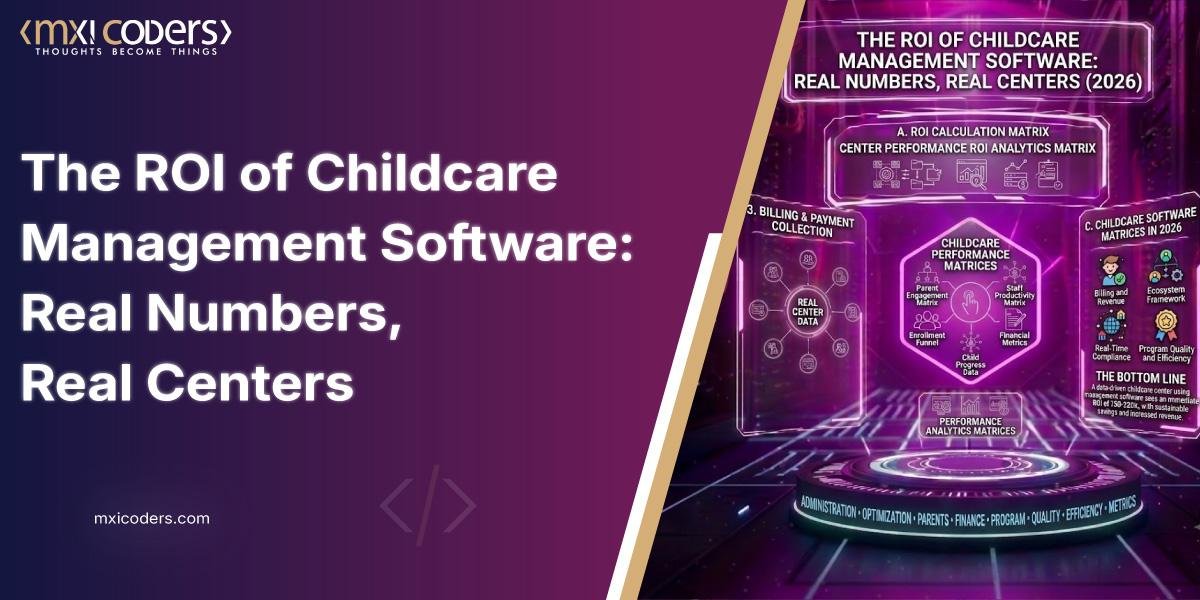
Childcare centers today are being squeezed from both sides. Staffing costs keep climbing, parents expect faster communication and more transparency, and licensing requirements keep adding paperwork to already busy days. According to industry surveys, administrative staff at a typical childcare center spend close to 15 to 20 hours a week on manual tasks like attendance logs, billing, and enrollment paperwork. That is nearly half of a full time role dedicated purely to admin work that software could automate in minutes.
This is where childcare management software has become less of a luxury and more of a business necessity. Centers that adopt it are not just digitizing paperwork, they are unlocking measurable financial returns. In this article, you will learn:
- How software delivers measurable ROI
- Real-world cost-saving examples from centers of different sizes
- Which features generate the highest financial returns
- How to calculate ROI for your own childcare center
➤ What Is Childcare Management Software?
Childcare management software is a digital platform built to handle the day-to-day operational needs of a daycare or preschool. Instead of juggling spreadsheets, paper sign-in sheets, and separate billing tools, centers run everything from one connected system.
The core purpose is simple: reduce manual work, minimize errors, and give directors real-time visibility into their business. It replaces fragmented processes with a single source of truth for children’s records, staff schedules, and family communication.
➥ Key Features
Most platforms in this category include:
- Digital attendance tracking
- Parent communication tools (messaging, photo sharing, updates)
- Billing and invoicing automation
- Online enrollment and waitlist management
- Staff scheduling
- Child records management
- Reporting and analytics
- Document management for licensing and compliance
➤ What Does ROI Mean for a Childcare Center?
➥ Beyond Revenue Growth
When people hear “ROI,” they often think purely in terms of new revenue. But for a childcare center, the return on childcare software investment shows up in several forms:
- Time savings for directors and administrative staff
- Reduced administrative workload across the board
- Lower operational costs from fewer manual processes
- Increased enrollment through easier onboarding
- Better parent retention thanks to improved communication
- Improved staff productivity
- Fewer billing errors and missed payments
- Stronger regulatory compliance and audit readiness
➥ Formula for Calculating ROI
A simple way to think about it:
ROI (%) = [(Total Benefits − Total Costs) / Total Costs] × 100
For example, if a center spends $6,000 a year on a software subscription and calculates $18,000 in combined labor savings, reduced late payments, and increased enrollment revenue, the ROI would be:
(($18,000 − $6,000) / $6,000) × 100 = 200%
Costs typically included are subscription fees, onboarding, and staff training time. Benefits included are labor hours saved, reduced billing errors, faster payment collection, and additional enrollment revenue.
➤ The Biggest Costs Childcare Centers Face Without Management Software
➥ Administrative Inefficiencies
Manual paperwork remains one of the biggest silent costs in this industry. Directors often re-enter the same information across multiple spreadsheets, which leads to duplicate data entry and scheduling conflicts that eat into staff time every single week.
➥ Revenue Leakage
Without automation, centers frequently deal with:
- Missed invoices that never get sent on time
- Late payments that go untracked
- Incorrect billing due to manual calculations
Each of these directly impacts cash flow, and over a year, the losses can add up to thousands of dollars.
➥ Communication Challenges
Parents calling to ask about pickup times, missed notifications about closures, and staff coordination issues all point to a communication gap that costs time and trust. A lack of centralized messaging often means important updates get lost entirely.
➥ Compliance Risks
Licensing documentation, attendance records, and audit preparation are areas where manual systems create real risk. A single missing form during an inspection can result in fines or, in serious cases, threaten a center’s license.
Also Read: Struggling to Manage Your Daycare? Here’s How Child Care Software Helps
➤ Real Numbers: How Childcare Management Software Delivers ROI
➥ Example 1: Administrative Time Savings
Centers that switch to automated systems commonly report saving 10 or more hours per week previously spent on manual attendance and billing tasks. Over a year, that translates into significant annual labor savings and lets staff focus on classroom quality instead of paperwork.
➥ Example 2: Faster Fee Collection
Automated invoicing paired with online payment options shortens the time between billing and collection. Centers see reduced outstanding balances because parents can pay instantly from a phone instead of writing checks or mailing payments.
➥ Example 3: Increased Enrollment
Online registration removes friction from the sign-up process. A shorter enrollment process, often cut from days to minutes, leads to improved conversion rates since prospective families are less likely to abandon a lengthy paper application.
➥ Example 4: Parent Retention
Better communication through daily updates and photo sharing increases parent satisfaction. Happier families are far less likely to switch centers, which directly supports lower churn and more predictable revenue.
➥ Example 5: Reduced Paper and Printing Costs
Moving to digital forms, cloud storage, and electronic reports eliminates recurring printing and paper costs, while also making records easier to retrieve during an inspection.
➤ ROI Breakdown by Childcare Center Size
➥ Small Centers (Under 50 Children)
Typical investment for a small center is modest, often a few hundred dollars a month. Expected savings come primarily from time recovered on billing and attendance, with many small centers reporting a payback period of just a few months.
➥ Medium Centers (50 to 150 Children)
At this scale, operational improvements compound. Centers gain access to better revenue opportunities through waitlist management and reduced fee collection delays, along with meaningful staff efficiency gains across multiple classrooms.
➥ Large Multi-Location Centers
For larger operations, the biggest gains come from centralized management across sites, standardized reporting that simplifies oversight, and scalability benefits that let a growing network add locations without proportionally growing administrative headcount.
➤ Signs Your Childcare Center Is Ready to Invest in Management Software
➥ Operational Indicators
If several of the following sound familiar, it may be time to evaluate a platform built for childcare center operations:
- Too much paperwork piling up weekly
- Frequent billing mistakes or missed payments
- Manual attendance tracking that eats into staff time
- A slow enrollment process that loses prospective families
- Growing parent communication demands your team can’t keep up with
- Multiple disconnected tools that don’t talk to each other
➤ Making the Case for Childcare Management Software
The financial case for childcare management software goes well beyond a simple subscription cost comparison. When you factor in time saved, reduced billing errors, faster fee collection, and stronger parent retention, the return often shows up within the first year of use. Just as importantly, the operational benefits, from smoother enrollment to easier compliance, contribute to a center that runs more smoothly day to day.
Before choosing a platform, take the time to look honestly at your current processes. Track how many hours your staff spend on manual tasks, how often billing errors occur, and how many families are lost during a clunky enrollment process. Those numbers, run through a simple ROI formula, will give you a clear picture of what the right software investment could mean for your center.