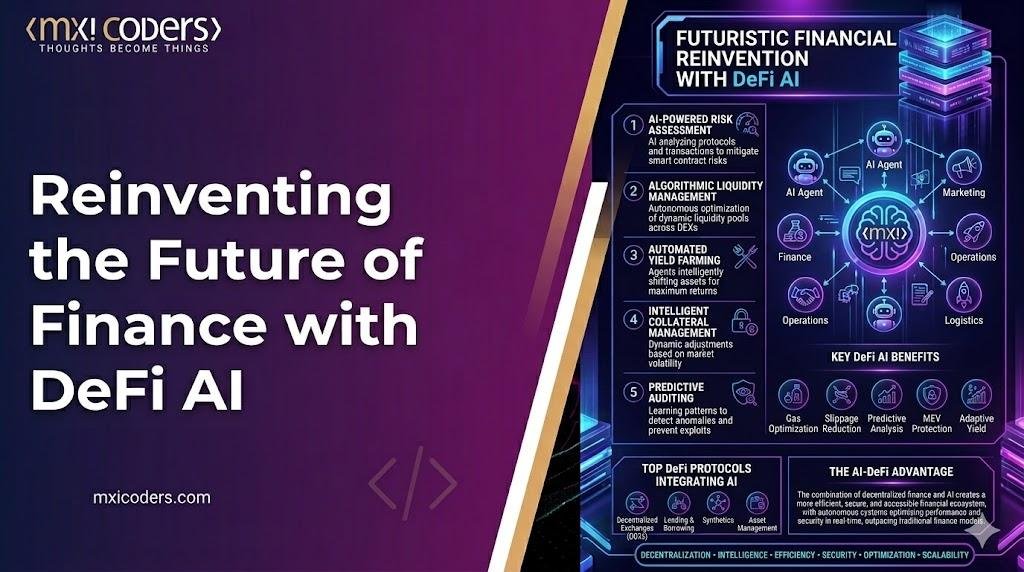
For years, banks and brokers sat in the middle of every transaction. Then DeFi showed up. It is based on blockchain, smart contracts and allows individuals to transfer money between each other without a middleman. The total value of the DeFi market in the world reached $20.48 billion in 2024. It’s projected to top $230 billion, growing at a 53.7% compound rate.
DeFi already made finance more open. Add AI and it gets sharper. DeFi AI or DeFAI puts autonomous agents inside those protocols. The result? Faster trades, smarter risk calls, and services that adapt while you sleep.
Let’s unpack what DeFAI actually does, why it matters for finance teams, and where it’s already working.
➤ What Is DeFAI and How Does It Work?
DeFAI is what happens when AI agents start running inside DeFi protocols. They don’t follow fixed scripts. They collect data, decide, and act across multiple steps.
Here’s the loop most agents use:
Gather
Agents fetch real-time information from blockchains, such as prices, liquidity pools, volumes, token balance, contract state, etc. Then they grab outside signals: social posts, news, sentiment shifts. Some oracles are on-chain, and return real world data such as FX rates or commodity prices.
Analyze
It is assessed by machine learning models for pattern, risks and opportunities. They spot trends a spreadsheet would miss. Models flag wash trading, sudden liquidity drains, or coordinated wallet behavior.
Decide and execute
The agent maps the best move for the goal. Maximizing yield? It considers the various aspects of returns, withdrawal policies, gas charges, and distributes the funds among protocols. It then directly communicates with smart contracts or APIs to complete the trade, transfer liquidity or modify a loan.
Monitor and learn
After the action, agents keep watching. Markets shift, so strategies shift too. They compare results to the plan and tweak the playbook for next time.
That’s different from a simple bot. A bot follows rules. An agent sets a goal and figures out how to hit it.
➤ DeFAI Benefits for Finance
Financial firms, fintechs, and end users all gain something here. Four wins show up repeatedly:
1. Automation that actually thinks
Agents perform tasks such as loan applications and portfolio rebalancing and trades without any human intervention. They are capable of reading the real-time data and can run smart contracts without the need for others. That cuts settlement times from hours to seconds.
2. Risk control in real time
Because agents never log off, they watch for fraud and odd market moves 24/7. They flag threats early, which cuts losses and keeps assets safer.
3. Lower cost, higher speed
Fewer manual steps means fewer errors. Tasks run faster and scale easier. You get reliability without ballooning headcount.
4. Finance for more people
Agents tailor advice and products to each user. They’re available all day long at your service. That kind of access pushes financial inclusion forward.
These points hit EEAT hard: real deployments show Experience, the technical detail shows Expertise, working with regulated data builds Trust, and citations back Authority.
➤ How AI Is Changing DeFi: Use Cases to Look at?
Intelligent trade execution
Token swaps live or die by price prediction across DEXs. Agents monitor prices, the liquidity level, volume, slippage, volatility, gas, and network load. Next, they feed in reinforcement learning and time-series models such as LSTM to predict short-term movements and arbitrage opportunities.
In that way, the agent can connect paths on DEXs, break down large trades into smaller ones to minimize the market impact, and execute trades at the right time. If conditions change, it adjusts. The outcome: lower fees, better fills, and speed humans can’t match. Teams also save hours they used to spend on manual routing checks. Less guesswork, more profit kept on the table. Traders don’t wait for a green light. The agent sees the opening and moves.
Personalized swap optimization
You wish to exchange Token A on Ethereum, with Token B on BSC. The agent verifies the congestion, fees, sentiment and liquidity. Then it layers in your history, risk appetite, and preferences.
Conservative traders get stable paths. Aggressive ones see higher-return options with more risk. Everyone gets a route that fits. That personalization is what Google’s Helpful Content systems have rewarded since August 2022 content and tools built for people first.
Liquidity provision that adapts
Liquidity providers want yield without nasty surprises like impermanent loss. DeFAI agents pull on-chain and off-chain data volumes, volatility, token correlations, trends to decide where capital should sit.
They move liquidity between pools as markets shift. They rebalance automatically, chase better fees, and dodge suspicious pools. Predictive models also simulate market shocks so LPs can pull funds before losses hit. Agents even factor in protocol-specific incentives and token emission schedules to squeeze more APR.
Automated loan management
Loan approval gets faster and fairer. When a borrower applies, agents aggregate on-chain history, credit proxies, and off-chain scores. Credit profiles update continuously.
AI models evaluate risk, predict repayment rates and calculate the rates on the fly. Approved? Smart contracts dispense money, monitor payments, modify the rates, and remind of payments. Collateral gets monitored too. If it drops below a threshold, liquidation triggers automatically to protect lenders. Borrowers get nudges before default, which cuts disputes and keeps reputations intact.
➤ DeFAI – What’s next?
Agents already handle swaps, liquidity, and loans. Next they’re tackling cross-chain identity, real-world asset tokenization, and DAO treasury ops. Each step cuts middlemen and speeds settlement. Regulators watch closely, so audit trails and explainable models aren’t optional. They’re the price of trust. The teams which keep recording the decisions and display their work will be the winners. DeFAI fits because it solves, not shouts.
➤ Rolling Out DeFAI with MXICoders
DeFAI can cut costs and tighten security. It is not an “off the shelf” solution though. You have highly sophisticated integrations, compliance rules and accountability questions to deal with.
MXICoders builds DeFi systems and knows the traps. We handle intelligent trading tools, loan applications, and DeFi wallet management. From AI-driven data analysis to platform customization and third-party blockchain integrations, we cover the full build.
The rules changed. Users and algorithms want systems that solve, not systems that posture.
Ready to put agents to work in your finance stack? Talk to MXICoders and map your first DeFAI workflow.
Don’t automate for the sake of it. Automate where it moves money.