Blockchain

What Is Blockchain Development? A Complete Beginner’s Guide

Ashok Rathod

Tech Consultant

Posted on
15th May 2026
11 min
Read
Share

Table of Contents

  • Quick Tips
  • Familiarize yourself with Cash App
  • Enable two-factor authentication
  • Utilize the optional Cash App
  • Conclusion

If you have been hearing the word “blockchain” everywhere lately and still feel a little fuzzy on what it actually means, you are not alone. Most explanations either go too deep into the technical weeds or stay so surface-level that you walk away knowing nothing useful. This guide tries to hit the middle ground.

Here is what is actually happening in the real world: companies across banking, healthcare, logistics, and even the government are putting serious money into blockchain. According to Grand View Research, the global blockchain market was valued at $17.57 billion in 2023 and is projected to grow at a CAGR of 87.7% through 2030. Gartner puts blockchain’s projected business value at $3.1 trillion by 2030. A Deloitte survey found that 83% of senior executives already see real use cases for it in their industries.

So this is not hype for hype’s sake. There is something genuinely useful going on here and understanding it starts with understanding what blockchain development actually is.

➤ What Is Blockchain Development?

➥ Blockchain Development Definition

Think of blockchain development as building software, except the software does not live on one company’s servers. Instead, it runs across a network of thousands of computers at once, and no single person or organization controls it.

When a developer builds a traditional app say, a banking app; all the data sits on the bank’s servers. The bank controls it. Blockchain development flips that model. Here, the data and the logic that governs it are distributed across a network, and the rules are enforced by code and math rather than by any central authority.

➥ What Does Blockchain Development Include?

Blockchain development is not one thing. It is a collection of related disciplines:

Smart contract development is probably the most talked-about area. Smart contracts are pieces of code that live on the blockchain and run automatically when certain conditions are met.

dApp development involves building applications that sit on top of blockchain networks instead of traditional servers. These decentralized applications handle everything from lending protocols to digital art markets.

Blockchain protocol development is the deeper engineering work designing the actual rules and architecture of a blockchain network itself.

Token development covers creating digital assets, whether that is a cryptocurrency, a governance token, or a utility token for a specific platform.

NFT platform development focuses on building the infrastructure for creating and trading non-fungible tokens, which represent unique ownership of a digital item.

➥ Why Blockchain Development Matters

The honest answer is that blockchain solves some real, stubborn problems that have existed in digital systems for decades.

Decentralization means no single point of failure. If one node goes down, the network keeps running. Transparency means that on a public blockchain, anyone can verify any transaction which is genuinely useful in contexts where trust between parties is weak. Security comes from the cryptographic structure itself; changing any historical record requires redoing an enormous amount of work across the entire chain, which makes tampering practically impossible. And removing intermediaries i.e. the banks, brokers, and clearinghouses that sit between parties in a transaction can reduce both cost and delay significantly.

None of these benefits are hypothetical. They are already being used in supply chain tracking, cross-border payments, digital identity, and more.

Also Read: The Future of Blockchain in Finance: Key Predictions for 2030

➤ How Blockchain Technology Works

➥ What Is a Blockchain?

A blockchain is best understood as a shared record book except thousands of people hold identical copies of it simultaneously, and nobody can quietly edit their copy without everyone else noticing.

Each “page” in that record book is a block. Blocks contain transaction data, a timestamp, and a unique fingerprint called a hash. Once a block is filled and added to the chain, it stays there permanently. You cannot go back and change it without breaking every block that came after it, which the network would immediately detect.

That immutability the inability to quietly alter past records is one of blockchain’s most valuable properties.

➥ How Transactions Are Verified

When you send cryptocurrency or trigger a smart contract, your transaction does not just get recorded automatically. It first has to be verified by the network.

Here is how that roughly works: your transaction gets broadcast to the network, where nodes pick it up and check it. They verify that your signature is valid and that you actually have what you are claiming to send. Once enough nodes agree it is legitimate  through a process called a consensus mechanism it gets bundled into a block and added to the chain.

Cryptographic security underpins all of this. The math involved makes it computationally infeasible to fake a valid transaction or forge someone’s signature. That is what makes the whole system trustworthy without needing a central authority to oversee it.

➥ What Are Nodes in Blockchain?

Nodes are just computers participating in the network. Each one holds a copy of the blockchain and helps verify transactions. The more nodes there are, the more decentralized and resilient the network becomes.

Full nodes store the entire history of the blockchain and enforce every rule. Light nodes store less data and are used in situations where storage or processing power is limited, like on a mobile wallet. Validator or miner nodes are the ones actually proposing new blocks and earning rewards for doing so.

➥ How Data Is Stored on Blockchain

Every block gets a unique hash a string of characters generated by running the block’s data through a cryptographic function. Change even one character in the block’s data and the hash changes entirely. Each block also contains the hash of the block before it, which is how the chain is formed.

This block-linking system means history is locked in. Pull one block out of sequence and the whole chain breaks. That is why blockchain records are effectively permanent not because of any law, but because of math.

➤ Main Types of Blockchain Development

➥ Public Blockchain Development

Public blockchains are open to anyone. You do not need permission to join, participate, or read the data. Bitcoin and Ethereum are the two most well-known examples.

Public chains prioritize decentralization and censorship resistance above everything else. That makes them ideal for cryptocurrency, open financial protocols, and any application where you want the network to be truly trustless. The tradeoffs are slower transaction speeds and, historically, higher fees during congestion.

➥ Private Blockchain Development

Private blockchains work more like traditional corporate software. One organization controls the network, decides who can join, and sets the rules. Outsiders cannot see in.

This might sound like it defeats the purpose, but for many businesses, it does not. A company might want the efficiency of a shared ledger among its partners without exposing sensitive commercial data to the world. Custom enterprise blockchain development in this space often involves building tailored systems for specific industries, with access controls, compliance features, and integration with existing software.

➥ Consortium Blockchain Development

A consortium blockchain sits between public and private. Instead of one company controlling the network, a group of organizations share governance. A consortium of five banks, for example, might jointly run a blockchain for interbank settlement each one operates some nodes and has a say in the rules, but outsiders are still kept out.

This model works well in industries where companies need to collaborate on shared infrastructure without fully trusting each other. Trade finance, pharmaceutical tracking, and energy markets are common use cases.

➥ Hybrid Blockchain Development

Hybrid blockchains let organizations pick what goes public and what stays private. A retailer might record product origin data publicly for consumer transparency while keeping its supplier pricing agreements private. It is a flexible approach for businesses that need to balance regulatory compliance with the credibility of public verification.

➤ Key Components of Blockchain Development

➥ Smart Contracts

A smart contract is code that lives on the blockchain and executes automatically when conditions are met. There is no middleman, no lawyer to call, no bank to approve, no manual process to wait on.

Imagine a freelancer who gets paid automatically the moment a client marks a milestone complete. Or a decentralized insurance policy that pays out instantly when flight delay data confirms a cancellation. That is smart contract working in practice.

Because smart contracts are immutable once deployed, bugs can be very expensive. That is why smart contract audit has become a standard part of the development process. Auditors (both human and automated tools) review the code before it goes live to catch vulnerabilities that could be exploited.

➥ Decentralized Applications (dApps)

dApps are applications built on top of blockchain networks, usually powered by smart contracts on the backend. To a user, a dApp might look like any other web app. Under the hood, no company controls the backend the logic runs on the blockchain itself.

Ethereum development has produced thousands of dApps across DeFi (lending, trading, yield farming), NFTs (art marketplaces, gaming items), and governance (DAOs where token holders vote on decisions). Some of the most widely used DeFi protocols now manage billions of dollars in assets with no CEO, no headquarters, and no customer service department.

➥ Cryptographic Security

Every blockchain interaction involves cryptography. When you create a wallet, you get a private key (keep it secret) and a public key (share it freely). Your private key signs transactions, proving they came from you. Anyone can verify that signature using your public key, but cannot reverse-engineer your private key from it.

This is what makes blockchain trustless. You do not need to trust the other party in a transaction, the math does the verification for you.

➥ Consensus Mechanisms

Proof of Work (PoW) is Bitcoin’s approach, miners compete to solve a computational puzzle, and the winner adds the next block. It is secure but energy-intensive.

Proof of Stake (PoS) replaced PoW on Ethereum in 2022. Validators put up cryptocurrency as collateral, and the network selects them to propose blocks proportionally. It uses far less energy and has become the dominant model for newer chains.

Delegated consensus models, like Delegated Proof of Stake, go further by letting token holders vote for a smaller set of delegates who do the validation work. It trades some decentralization for speed and efficiency.

➥ Blockchain Wallets

A blockchain wallet does not actually hold your crypto, it holds the keys that prove you own it. Your public key is your address; your private key is your proof of ownership.

Lose your private key and there is no customer support line to call, no password reset email. That is one of the real tradeoffs of decentralization, more control, but also more responsibility.

➤ Popular Blockchain Development Platforms

➥ Ethereum

Ethereum is where most of the developer activity happens. It was the first platform to introduce smart contracts at scale, and it has the largest ecosystem of tools, documentation, and developer communities. If you are learning blockchain development, Ethereum is almost certainly where you start.

➥ Solana

Solana trades some decentralization for raw speed. It can process tens of thousands of transactions per second at very low cost, making it practical for applications where Ethereum’s fees would be a dealbreaker, gaming, micropayments, high-frequency trading.

➥ Polygon

Polygon is essentially an add-on to Ethereum. It processes transactions faster and cheaper on its own chain, then settles them on Ethereum’s mainnet. For projects that want Ethereum’s credibility but cannot afford its gas fees, Polygon has become a go-to solution.

➥ Hyperledger

Hyperledger is not a public blockchain, it is an enterprise framework for building permissioned systems. Custom enterprise blockchain development in regulated industries often runs on Hyperledger Fabric, which gives businesses the structure and access controls they need without the openness of a public chain.

➤ Conclusion

Blockchain development is genuinely interesting because it is not just a new technology, it is a different way of thinking about trust, ownership, and control in digital systems.

The core idea is simple: instead of relying on a central authority to keep records honest, you use mathematics and a distributed network to make dishonesty impractical. From that simple idea flows everything else smart contracts, dApps, DeFi, NFTs, and the broader Web3 vision of a more user-owned internet.

There are real challenges around scalability, regulation, user experience, and energy consumption that developers and researchers are actively working through. But the direction of travel is clear. Enterprise blockchain, decentralized finance, and programmable digital assets are not going away, they are becoming more embedded in how the global economy functions.

Whether you are considering a career in the space, evaluating blockchain for a business use case, or just trying to understand what all the noise is about, the time you spend getting to grips with the fundamentals will be well worth it.
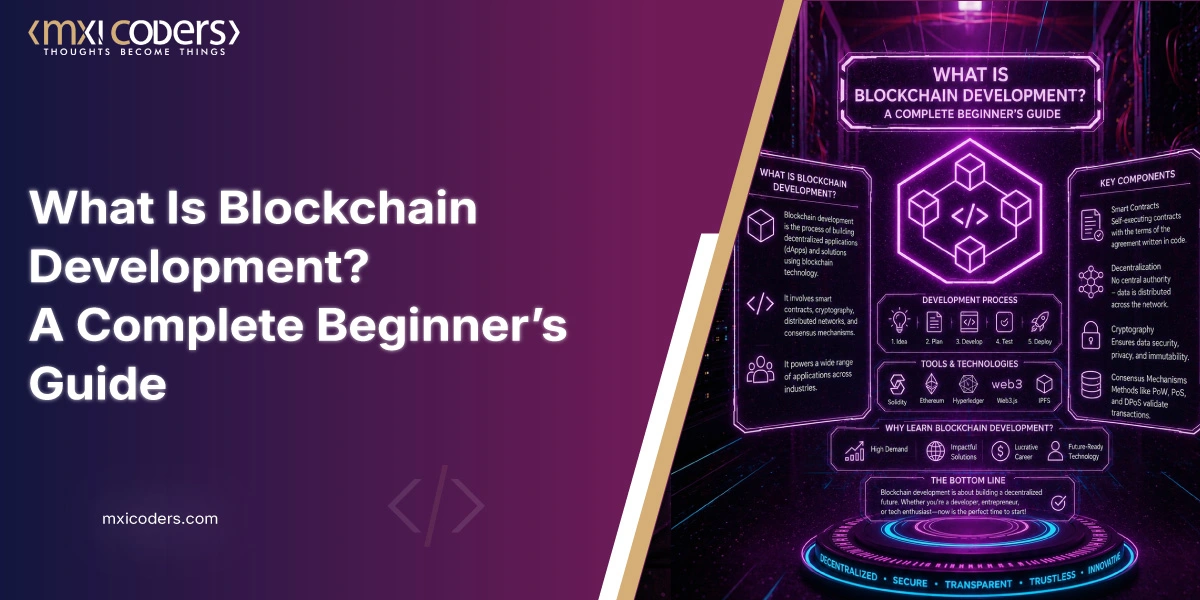
what is blockchain development

If you have been hearing the word “blockchain” everywhere lately and still feel a little fuzzy on what it actually means, you are not alone. Most explanations either go too deep into the technical weeds or stay so surface-level that you walk away knowing nothing useful. This guide tries to hit the middle ground.

Here is what is actually happening in the real world: companies across banking, healthcare, logistics, and even the government are putting serious money into blockchain. According to Grand View Research, the global blockchain market was valued at $17.57 billion in 2023 and is projected to grow at a CAGR of 87.7% through 2030. Gartner puts blockchain’s projected business value at $3.1 trillion by 2030. A Deloitte survey found that 83% of senior executives already see real use cases for it in their industries.

So this is not hype for hype’s sake. There is something genuinely useful going on here and understanding it starts with understanding what blockchain development actually is.

➤ What Is Blockchain Development?

➥ Blockchain Development Definition

Think of blockchain development as building software, except the software does not live on one company’s servers. Instead, it runs across a network of thousands of computers at once, and no single person or organization controls it.

When a developer builds a traditional app say, a banking app; all the data sits on the bank’s servers. The bank controls it. Blockchain development flips that model. Here, the data and the logic that governs it are distributed across a network, and the rules are enforced by code and math rather than by any central authority.

➥ What Does Blockchain Development Include?

Blockchain development is not one thing. It is a collection of related disciplines:

Smart contract development is probably the most talked-about area. Smart contracts are pieces of code that live on the blockchain and run automatically when certain conditions are met.

dApp development involves building applications that sit on top of blockchain networks instead of traditional servers. These decentralized applications handle everything from lending protocols to digital art markets.

Blockchain protocol development is the deeper engineering work designing the actual rules and architecture of a blockchain network itself.

Token development covers creating digital assets, whether that is a cryptocurrency, a governance token, or a utility token for a specific platform.

NFT platform development focuses on building the infrastructure for creating and trading non-fungible tokens, which represent unique ownership of a digital item.

➥ Why Blockchain Development Matters

The honest answer is that blockchain solves some real, stubborn problems that have existed in digital systems for decades.

Decentralization means no single point of failure. If one node goes down, the network keeps running. Transparency means that on a public blockchain, anyone can verify any transaction which is genuinely useful in contexts where trust between parties is weak. Security comes from the cryptographic structure itself; changing any historical record requires redoing an enormous amount of work across the entire chain, which makes tampering practically impossible. And removing intermediaries i.e. the banks, brokers, and clearinghouses that sit between parties in a transaction can reduce both cost and delay significantly.

None of these benefits are hypothetical. They are already being used in supply chain tracking, cross-border payments, digital identity, and more.

Also Read: The Future of Blockchain in Finance: Key Predictions for 2030

➤ How Blockchain Technology Works

➥ What Is a Blockchain?

A blockchain is best understood as a shared record book except thousands of people hold identical copies of it simultaneously, and nobody can quietly edit their copy without everyone else noticing.

Each “page” in that record book is a block. Blocks contain transaction data, a timestamp, and a unique fingerprint called a hash. Once a block is filled and added to the chain, it stays there permanently. You cannot go back and change it without breaking every block that came after it, which the network would immediately detect.

That immutability the inability to quietly alter past records is one of blockchain’s most valuable properties.

➥ How Transactions Are Verified

When you send cryptocurrency or trigger a smart contract, your transaction does not just get recorded automatically. It first has to be verified by the network.

Here is how that roughly works: your transaction gets broadcast to the network, where nodes pick it up and check it. They verify that your signature is valid and that you actually have what you are claiming to send. Once enough nodes agree it is legitimate  through a process called a consensus mechanism it gets bundled into a block and added to the chain.

Cryptographic security underpins all of this. The math involved makes it computationally infeasible to fake a valid transaction or forge someone’s signature. That is what makes the whole system trustworthy without needing a central authority to oversee it.

➥ What Are Nodes in Blockchain?

Nodes are just computers participating in the network. Each one holds a copy of the blockchain and helps verify transactions. The more nodes there are, the more decentralized and resilient the network becomes.

Full nodes store the entire history of the blockchain and enforce every rule. Light nodes store less data and are used in situations where storage or processing power is limited, like on a mobile wallet. Validator or miner nodes are the ones actually proposing new blocks and earning rewards for doing so.

➥ How Data Is Stored on Blockchain

Every block gets a unique hash a string of characters generated by running the block’s data through a cryptographic function. Change even one character in the block’s data and the hash changes entirely. Each block also contains the hash of the block before it, which is how the chain is formed.

This block-linking system means history is locked in. Pull one block out of sequence and the whole chain breaks. That is why blockchain records are effectively permanent not because of any law, but because of math.

➤ Main Types of Blockchain Development

➥ Public Blockchain Development

Public blockchains are open to anyone. You do not need permission to join, participate, or read the data. Bitcoin and Ethereum are the two most well-known examples.

Public chains prioritize decentralization and censorship resistance above everything else. That makes them ideal for cryptocurrency, open financial protocols, and any application where you want the network to be truly trustless. The tradeoffs are slower transaction speeds and, historically, higher fees during congestion.

➥ Private Blockchain Development

Private blockchains work more like traditional corporate software. One organization controls the network, decides who can join, and sets the rules. Outsiders cannot see in.

This might sound like it defeats the purpose, but for many businesses, it does not. A company might want the efficiency of a shared ledger among its partners without exposing sensitive commercial data to the world. Custom enterprise blockchain development in this space often involves building tailored systems for specific industries, with access controls, compliance features, and integration with existing software.

➥ Consortium Blockchain Development

A consortium blockchain sits between public and private. Instead of one company controlling the network, a group of organizations share governance. A consortium of five banks, for example, might jointly run a blockchain for interbank settlement each one operates some nodes and has a say in the rules, but outsiders are still kept out.

This model works well in industries where companies need to collaborate on shared infrastructure without fully trusting each other. Trade finance, pharmaceutical tracking, and energy markets are common use cases.

➥ Hybrid Blockchain Development

Hybrid blockchains let organizations pick what goes public and what stays private. A retailer might record product origin data publicly for consumer transparency while keeping its supplier pricing agreements private. It is a flexible approach for businesses that need to balance regulatory compliance with the credibility of public verification.

➤ Key Components of Blockchain Development

➥ Smart Contracts

A smart contract is code that lives on the blockchain and executes automatically when conditions are met. There is no middleman, no lawyer to call, no bank to approve, no manual process to wait on.

Imagine a freelancer who gets paid automatically the moment a client marks a milestone complete. Or a decentralized insurance policy that pays out instantly when flight delay data confirms a cancellation. That is smart contract working in practice.

Because smart contracts are immutable once deployed, bugs can be very expensive. That is why smart contract audit has become a standard part of the development process. Auditors (both human and automated tools) review the code before it goes live to catch vulnerabilities that could be exploited.

➥ Decentralized Applications (dApps)

dApps are applications built on top of blockchain networks, usually powered by smart contracts on the backend. To a user, a dApp might look like any other web app. Under the hood, no company controls the backend the logic runs on the blockchain itself.

Ethereum development has produced thousands of dApps across DeFi (lending, trading, yield farming), NFTs (art marketplaces, gaming items), and governance (DAOs where token holders vote on decisions). Some of the most widely used DeFi protocols now manage billions of dollars in assets with no CEO, no headquarters, and no customer service department.

➥ Cryptographic Security

Every blockchain interaction involves cryptography. When you create a wallet, you get a private key (keep it secret) and a public key (share it freely). Your private key signs transactions, proving they came from you. Anyone can verify that signature using your public key, but cannot reverse-engineer your private key from it.

This is what makes blockchain trustless. You do not need to trust the other party in a transaction, the math does the verification for you.

➥ Consensus Mechanisms

Proof of Work (PoW) is Bitcoin’s approach, miners compete to solve a computational puzzle, and the winner adds the next block. It is secure but energy-intensive.

Proof of Stake (PoS) replaced PoW on Ethereum in 2022. Validators put up cryptocurrency as collateral, and the network selects them to propose blocks proportionally. It uses far less energy and has become the dominant model for newer chains.

Delegated consensus models, like Delegated Proof of Stake, go further by letting token holders vote for a smaller set of delegates who do the validation work. It trades some decentralization for speed and efficiency.

➥ Blockchain Wallets

A blockchain wallet does not actually hold your crypto, it holds the keys that prove you own it. Your public key is your address; your private key is your proof of ownership.

Lose your private key and there is no customer support line to call, no password reset email. That is one of the real tradeoffs of decentralization, more control, but also more responsibility.

➤ Popular Blockchain Development Platforms

➥ Ethereum

Ethereum is where most of the developer activity happens. It was the first platform to introduce smart contracts at scale, and it has the largest ecosystem of tools, documentation, and developer communities. If you are learning blockchain development, Ethereum is almost certainly where you start.

➥ Solana

Solana trades some decentralization for raw speed. It can process tens of thousands of transactions per second at very low cost, making it practical for applications where Ethereum’s fees would be a dealbreaker, gaming, micropayments, high-frequency trading.

➥ Polygon

Polygon is essentially an add-on to Ethereum. It processes transactions faster and cheaper on its own chain, then settles them on Ethereum’s mainnet. For projects that want Ethereum’s credibility but cannot afford its gas fees, Polygon has become a go-to solution.

➥ Hyperledger

Hyperledger is not a public blockchain, it is an enterprise framework for building permissioned systems. Custom enterprise blockchain development in regulated industries often runs on Hyperledger Fabric, which gives businesses the structure and access controls they need without the openness of a public chain.

➤ Conclusion

Blockchain development is genuinely interesting because it is not just a new technology, it is a different way of thinking about trust, ownership, and control in digital systems.

The core idea is simple: instead of relying on a central authority to keep records honest, you use mathematics and a distributed network to make dishonesty impractical. From that simple idea flows everything else smart contracts, dApps, DeFi, NFTs, and the broader Web3 vision of a more user-owned internet.

There are real challenges around scalability, regulation, user experience, and energy consumption that developers and researchers are actively working through. But the direction of travel is clear. Enterprise blockchain, decentralized finance, and programmable digital assets are not going away, they are becoming more embedded in how the global economy functions.

Whether you are considering a career in the space, evaluating blockchain for a business use case, or just trying to understand what all the noise is about, the time you spend getting to grips with the fundamentals will be well worth it.

Ready to transform your business with smart software solutions?

Harness the power of custom software development to streamline operations, reduce costs, and boost efficiency. Start by exploring cutting-edge approaches like cloud-native platforms, API-first architecture, and AI-driven automation to future-proof your systems and stay ahead of the competition.

Book free consultation

Let’s build your idea together and serve society.

Author

Ashok Rathod

Tech Consultant

Experience
25 Years
Growth Architect for Startups & SMEs | Blockchain, AI , MVP Development, & Data-Driven Marketing Expert.

Transform the Carbon Credit Industry

Build a Transparent, Scalable Carbon Credit Marketplace with Blockchain.

Index