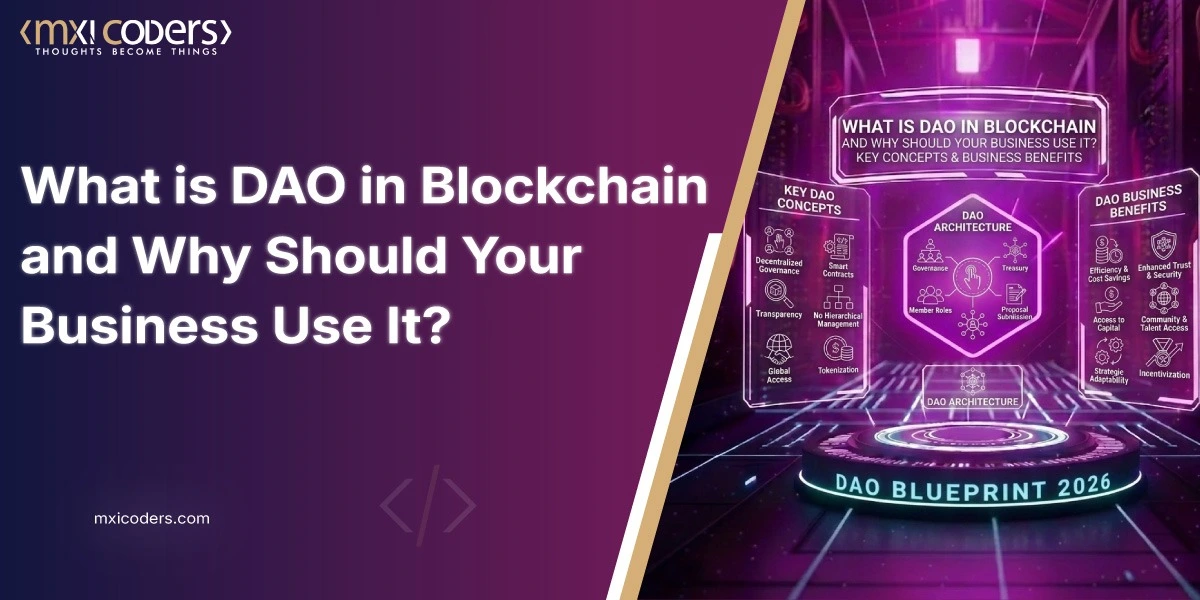
Blockchain keeps throwing around terms that sound impressive until you actually try to understand them. DAO is one of those terms. You’ve probably seen it mentioned alongside DeFi, Web3, and NFTs but what does it actually mean for your business?
Here’s what makes it worth paying attention to: there are now over 13,000 active DAOs worldwide, collectively managing more than $24.5 billion in treasury assets and engaging over 11 million governance token holders. That’s not a niche experiment anymore, that’s a parallel economy running on code instead of corner offices.
Yet despite all the momentum, most business owners still can’t explain what a DAO actually does or whether it’s relevant to them which is a problem when the technology is evolving this fast.
This guide breaks it down in plain language, walks you through how it works, and helps you decide whether a DAO model makes sense for what you’re building.
➤ What is a DAO in Blockchain?
A Decentralized Autonomous Organization, or DAO, is essentially an organization that runs on code instead of people in suits. There’s no CEO making decisions, no board voting behind closed doors, and no HR department sending passive-aggressive emails. Instead, rules are written into smart contracts that live on a blockchain, and every decision is made collectively by the people who hold the organization’s governance tokens.
Think of it like a company where the rulebook is public, unchangeable without community approval, and enforced automatically no human in the middle needed.
How DAOs remove centralized control is simpler than it sounds. In a traditional company, power flows from the top down. In a DAO, power is distributed across token holders. Nobody can unilaterally change the rules, freeze funds, or kick out members without the community’s agreement.
Blockchain is the backbone that makes all of this possible. It provides the immutable, transparent ledger where all decisions, votes, and transactions are recorded. Once something is written to the chain, it can’t be quietly edited or deleted.
The three key components that hold a DAO together are:
- Smart contracts — self-executing code that defines what the organization can and can’t do. Think of these as bylaws that enforce themselves.
- Governance tokens — digital tokens that represent voting power. The more tokens you hold, the more say you have (though some DAOs use alternative models to prevent whale dominance).
- Community voting mechanisms — on-chain or off-chain systems that let token holders propose changes, debate them, and vote on outcomes.
➤ How DAO Works in Blockchain (Step-by-Step)
Here’s what actually happens when a DAO makes a decision:
Step 1 — Smart contracts define the rules. Before a DAO launches, developers write the governance logic into smart contracts. These contracts specify things like: who can submit proposals, what percentage of votes are needed to pass something, how long voting windows last, and what happens when a vote succeeds or fails. If your business works with a smart contract development agency, they’ll help you design these parameters to match your governance goals.
Step 2 — Token holders gain voting rights. When you hold governance tokens, you’re essentially a shareholder with a vote. Tokens can be earned, purchased, or distributed to community members based on their contributions.
Step 3 — Someone submits a proposal. Any eligible token holder can put forward a proposal — say, “let’s allocate 50,000 USDC to fund a marketing campaign” or “let’s change the protocol fee from 0.3% to 0.25%.” Proposals are usually submitted on-chain or through a governance platform like Snapshot.
Step 4 — The community votes. Token holders vote yes, no, or abstain during a set voting period. Votes are recorded transparently and anyone can audit them.
Step 5 — The smart contract executes the outcome. If the vote passes the required threshold, the smart contract automatically carries out the decision. Funds move, parameters change, or new rules take effect without anyone needing to manually push a button or sign off.
This is what makes DAOs genuinely different from traditional governance: there’s no implementation delay, no bureaucratic lag, and no one quietly ignoring a decision they didn’t like.
Also Read: What Is dApp in Blockchain? Meaning, Examples, and How It Works
➤ Key Features of DAO in Blockchain
What separates a DAO from a regular community or company?
Decentralization is the core feature. No single person or entity has unilateral control. Even the founders of a DAO can’t simply override community decisions unless the community votes to let them.
Transparency is baked in. Every vote, every treasury transaction, every smart contract interaction is recorded on-chain. Anyone in the world can audit a DAO’s finances and decision history in real time. Compare that to a corporation where shareholders often have no idea how their money is actually being spent.
Automation via smart contracts removes human error and bias from execution. If a proposal passes, it executes. Period.
Community-driven governance means the people most affected by decisions are the ones making them. This sounds idealistic, but in practice it creates strong alignment between the organization’s direction and its stakeholders’ interests.
Global participation without intermediaries means anyone with a wallet and tokens can be a voting member regardless of geography, nationality, or employment status. A developer in Ahmedabad and an investor in Austin have equal access to governance.
➤ Types of DAOs You Should Know
DAOs aren’t one-size-fits-all. Here’s how they typically break down:
Protocol DAOs govern decentralized finance platforms. Uniswap, Aave, and Compound are classic examples. Token holders vote on protocol upgrades, fee structures, and which assets get listed.
Investment DAOs pool capital from members and collectively decide where to invest it. Think of them as decentralized venture funds where the LPs are also the decision-makers.
Service DAOs function like decentralized agencies or talent networks. Members offer skills like development, design, legal, marketing and the DAO coordinates and compensates work. If you’re building a platform that connects talent globally, this model is worth studying.
Social DAOs are community-first. They organize around shared interests, identities, or causes with tokens functioning as membership passes rather than financial instruments.
Collector DAOs pool resources to acquire high-value NFTs, digital art, or physical assets. PleasrDAO, which famously bought the Wu-Tang Clan album, is probably the most well-known example.
➤ Real-World DAO Examples in Blockchain
Let’s look at where DAOs are actually working in practice:
Finance (DeFi governance): MakerDAO governs the DAI stablecoin. MKR token holders vote on risk parameters, collateral types, and stability fees. Billions of dollars in assets are managed entirely through this community governance model.
Gaming: Axie Infinity’s community treasury and Decentraland’s governance give players real ownership over the games they spend time in. Players vote on new features, land policies, and content guidelines not a product team in San Francisco.
NFTs and digital ownership: Nouns DAO auctions one NFT every day, and proceeds go to a community treasury. NFT holders vote on how to spend it funding public goods, art projects, and charitable causes.
Venture funding: The LAO is a member-directed investment club where members pool ETH and vote on early-stage crypto investments. It’s functioning venture capital, minus the general partners taking a 20% carry.
➤ Benefits of DAO for Businesses
If you’re considering whether a DAO structure makes sense, here’s what you stand to gain:
Reduced operational costs come from cutting intermediaries. No lawyers to manage every internal transaction, no compliance officers needed for routine decisions, no expensive executive layer maintaining itself.
Faster decision-making through automation once a vote passes, execution is immediate. There’s no implementation committee, no waiting for a quarterly board meeting.
Increased transparency and trust is arguably the biggest business benefit. When your users and investors can audit your treasury in real time, it fundamentally changes the trust dynamic. This matters especially if you’re trying to build credibility in a skeptical market.
Global community engagement lets you bring in contributors, investors, and stakeholders from anywhere in the world and give them real ownership in the outcome.
Flexible governance models mean you can design a DAO that fits your specific needs. Some DAOs give equal votes to all members. Others weight votes by contribution history. The model is adaptable, not fixed.
➤ When Should a Business Use a DAO?
A DAO isn’t the right answer for every business. Here’s where it genuinely shines and where it falls flat.
➥ Good fits for a DAO structure:
Community-driven platforms where users are also stakeholders benefit enormously from giving those users a governance voice. If your users care deeply about the platform’s direction, token-based governance turns passive users into active advocates.
Decentralized finance projects almost require DAO governance at maturity. Regulatory pressure and user trust both push DeFi protocols toward decentralized control rather than a central team holding the keys.
Open-source ecosystems where contributors from across the world add value benefit from transparent, community-controlled treasuries that reward contributors fairly.
➥ When NOT to use a DAO:
If your business requires strict operational control or a clear chain of command say, you’re running a healthcare company or a regulated financial institution. A DAO’s community governance will slow you down and create compliance nightmares.
In high regulatory environments (banking, securities, healthcare), DAO structures face serious legal ambiguity. Token holders can be classified as securities investors in some jurisdictions, and a business operating as a DAO may have unclear legal liability. This is an evolving space, but if your business needs to move fast and stay compliant, the regulatory uncertainty alone may rule it out.
When you need fast, unilateral decisions, pivoting strategy overnight, responding to a market emergency, terminating a partnership, community governance isn’t your friend. A vote that takes five days to conclude is a liability when you need to act in five hours.
If you want to explore whether a DAO structure fits your technical roadmap, teams offering custom enterprise blockchain development can help you model the governance architecture before you commit.
➥ Should Your Business Use a DAO? (Final Verdict)
Here’s a simple way to think through the decision:
Ask yourself these questions:
- Do you need decentralization? If your business genuinely benefits from distributing power across a community rather than keeping control centralized. A DAO structure makes sense. If decentralization is just a marketing angle, it isn’t worth the complexity.
- Can your business handle community governance? DAOs require active, engaged communities. A DAO with low voter participation is effectively no governance at all. If you don’t have a community that cares enough to vote, you don’t have a functional DAO.
- Are you prepared for regulatory uncertainty? DAO legal frameworks are still being defined globally. Some jurisdictions (like Wyoming in the US) have DAO-specific legislation; most don’t. You need legal counsel that understands this space.
➥ Clear yes scenarios:
- You’re building a DeFi protocol and need decentralized governance to build user trust
- You’re creating a global contributor network and want transparent compensation and decision-making
- You’re launching a community-owned platform where users are the primary stakeholders
➥ Clear no scenarios:
- You’re a traditional business that needs to move quickly and maintain hierarchical control
- You operate in a heavily regulated industry with strict compliance requirements
- Your user base isn’t interested in governance participation they just want the product
The honest answer is that DAOs are genuinely powerful for the right use case and genuinely problematic for the wrong one. Understand your business model first, then decide whether decentralized governance serves it not the other way around.