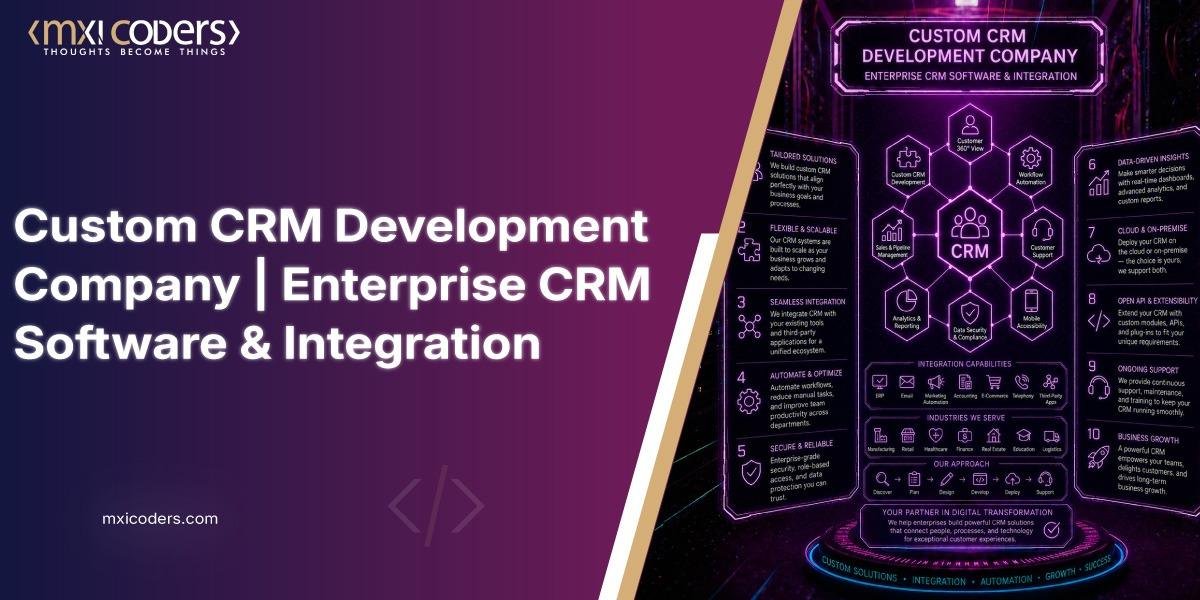
A custom CRM system is software built specifically around one company’s sales, service, or operational workflow, rather than configured inside a shared commercial platform. Businesses typically choose it over an off the shelf CRM when their processes don’t fit standard modules, when they need full data ownership, or when per seat licensing costs would exceed a one time build over a few years.
➤ What Does a CRM Software Development Company Actually Build?
A CRM software development company usually works across four distinct services rather than one product: consulting on whether to build or buy, implementation of an existing platform, ground up custom development, and mobile access layered on top. These aren’t interchangeable. Consulting is a diagnostic step. Implementation configures software someone else built. Custom development produces something owned outright.
CRM consulting services assess a company’s sales and service workflows before any code gets written, and recommend whether an off the shelf platform, a customized instance of one, or a fully custom build fits the budget and the complexity of the process.
CRM implementation takes an existing platform, commercial or custom, and configures it to a company’s actual data structure, user roles, and reporting needs. Most failed CRM rollouts fail here, not in the software itself.
Custom CRM development means building the system from the ground up: data model, workflow logic, and integrations designed around one company’s process instead of a vendor’s assumptions about every company’s process.
CRM integration services connect the CRM to the rest of the stack, ERP systems, marketing automation, email, and finance tools, so customer data doesn’t sit in a silo.
➤ How Much Does Custom CRM Development Actually Cost in 2026?
Cost depends far more on integration depth than on screen count. A basic system with contact management and pipeline tracking generally runs in the tens of thousands of dollars, while an enterprise build with AI features and deep ERP integration can run well past six figures. Complex, bidirectional integrations with systems like SAP or Oracle, or with legacy platforms and custom APIs, tend to be the single biggest driver of final price, sometimes exceeding the base build cost on their own.
For comparison, commercial platforms charge per user indefinitely. Salesforce’s Enterprise tier for Sales Cloud lists at $175 per user per month as of a July 2026 pricing check, which means a fifty person team is paying roughly $100,000 a year in licensing alone, every year, with no path to ownership. Twelverays
| Option | Mechanism | Best fit | Trade-off |
| Off the shelf (Salesforce, HubSpot) | Per user subscription, vendor maintained | Standard sales processes, fast time to launch | Recurring cost scales forever with headcount |
| Custom CRM development | One time build, internally or externally owned | Non standard workflows, data ownership priorities | Higher upfront cost, longer time to launch |
| Hybrid (customized instance of a commercial platform) | Configuration and light development on top of existing software | Mostly standard needs with a few unique requirements | Still carries per user fees, customization ceiling exists |
➤ When Does a Custom Build Actually Beat a Subscription?
For teams running roughly fifty or more seats with workflows that don’t map cleanly onto a vendor’s data model, a custom system typically becomes cheaper than a per user subscription within two to three years, since the build cost is fixed while subscription costs compound with every hire. Below that headcount, or where compliance and third party support matter more than ownership, an off the shelf platform or a customized instance of one is usually the lower risk path.
The global CRM software market grew from about $101 billion in 2024 to roughly $113 billion in 2025, and Fortune Business Insights projects it will reach $126.17 billion in 2026, which signals that demand for CRM in some form, custom or commercial, is still accelerating rather than plateauing. That growth is a reason to make the build versus buy decision deliberately rather than defaulting to whichever a sales team suggests first. Companies HistoryFortune Business Insights
➤ What Does CRM Integration Actually Involve?
Integration is rarely a single connector. A CRM feeding into an ERP system needs bidirectional data flow so inventory, invoicing, and customer records stay in sync in both directions, not just pushed one way. Marketing automation integration needs to pass lead scoring and campaign attribution back into the CRM record, not just export contacts into it. The teams that underestimate CRM projects almost always underestimate this layer specifically, treating it as a checkbox rather than a separate body of engineering work with its own testing and failure modes.
➤ Limitations, Caveats, and Industry Challenges
Custom CRM development carries real risk that a subscription doesn’t. The company owns ongoing maintenance, security patching, and feature development indefinitely, none of which a commercial vendor handles anymore once the contract ends. Cost estimates in this space also vary widely between development partners depending on team location, seniority, and how integration complexity is scoped, so any range quoted here should be treated as a starting point for a conversation, not a fixed quote. Businesses evaluating this path should get a documented scope before comparing vendor pricing, since undocumented scope is the most common reason final costs exceed the original estimate.
➤ Frequently asked questions
- Is a custom CRM cheaper than Salesforce or HubSpot long term?
For larger teams, yes, because subscription costs compound with every added seat while a custom build’s core cost is fixed. For smaller teams under roughly fifty users, the math usually favors a subscription since the build cost takes longer to pay back. - How long does custom CRM development take?
Timelines depend heavily on integration count rather than user interface complexity. A basic system can launch in a couple of months, while a build with deep ERP or legacy system integration typically takes several months longer, largely due to testing bidirectional data flows. - Can a custom CRM include AI features?
Yes, and in 2026 most enterprise builds do, typically for lead scoring, automated summaries, or predictive forecasting. These features add meaningfully to both the build cost and the ongoing infrastructure needed to keep the underlying data clean enough for the AI to be useful. - Do I need CRM consulting before development, or can I skip straight to a build?
Skipping the consulting step is the most common reason custom CRM projects end up rebuilt within two years. A short consulting phase that maps current workflows against build versus buy criteria is cheap relative to redoing a full build.
➤ Conclusion
The build versus buy decision for CRM software comes down to one honest question: is managing customer data core to the business, or a distraction from it. Teams with standard sales processes and modest headcount are almost always better served by a well configured commercial platform. Teams with genuinely non standard workflows, real integration complexity, and headcount that makes per seat licensing expensive over time have a legitimate case for a custom build, provided the scoping and integration work gets the attention it needs before a single line of code gets written.
Mxicoders has spent years building custom CRM systems, handling CRM integration services, and consulting with enterprises, agencies, and startups on exactly this build versus buy decision. If you’re weighing a custom CRM system against a commercial platform, or need to hire a CRM developer for an existing build, get in touch for a scoped consultation.
➤ Sources Used
- Fortune Business Insights, Customer Relationship Management (CRM) Market report
- CRM Market Size Statistics 2026, (Citing Fortune Business Insights figures)
- Salesforce Sales Cloud pricing, verified against official Salesforce pricing pages, July 2026