[ Your Headline ] [ Highlight Word ]

[ One or two lines describing the offer — e.g. "Experience our services with a FREE 30-minute consultation." ]

[ Optional second line, e.g. "Have a concept in mind? Let's brainstorm together!" ]

Google ★★★★★ 4.8
GoodFirms ★★★★★ 4.7
Clutch ★★★★★ 5.0
Software Project Management

Crypto Wallet Online: How Digital Currency Moves Through Your Digital Wallet

Ashok Rathod

Tech Consultant

Posted on
17th Jul 2026
6 min
Read
Share

Table of Contents

  • Quick Tips
  • Familiarize yourself with Cash App
  • Enable two-factor authentication
  • Utilize the optional Cash App
  • Conclusion

A crypto wallet online lets you hold, send, and receive digital currency like Bitcoin or Ethereum without a bank in the middle. It stores the private keys that prove ownership on the blockchain, not the coins themselves, which is the single most important thing to understand before using one for online money transfer.

➤ What Is the Difference Between a Digital Wallet and a Crypto Wallet Online?

A digital wallet, the kind built into Apple Pay, Google Pay, or a banking app, stores tokenized versions of your existing bank cards and moves fiat currency through existing payment rails. A crypto wallet online does something structurally different. It generates and stores a private key, a cryptographic string that authorizes transactions directly on a blockchain, with no bank or card network involved at all. Both are “digital,” but only one of them removes the intermediary entirely.

This distinction matters more than it did a few years ago. Global cryptocurrency ownership reached 741 million people in 2025, up 12.4 percent from 659 million in 2024, according to Crypto.com’s Crypto Market Sizing Report. Bitcoin alone accounted for roughly 365 million of those owners. That’s not a niche experiment anymore, it’s a parallel payment rail that a meaningful share of the connected population now touches regularly.

➤ How Does a Crypto Wallet Online Actually Store Your Digital Currency?

OptionMechanismBest FitTrade-off
Custodial walletA third party, usually an exchange, holds your private keys on your behalfBeginners who want password recovery and customer supportYou don’t fully control your funds; exchange failures or freezes can block access
Non-custodial hot walletYou hold the private key, but it lives on an internet-connected app or deviceFrequent traders who need fast accessConstant internet connectivity increases exposure to phishing and malware
Non-custodial cold wallet (hardware)Private keys are generated and stored on an offline physical deviceLong-term holders prioritizing security over convenienceLosing the device or seed phrase without a backup means permanent loss of funds

Every wallet falls into one of two categories based on who controls the private key, and a second split based on whether that key ever touches the internet.Non-custodial wallets, both hot and cold combined, now make up roughly 59 percent of all crypto wallets in use, according to Sumsub’s 2026 wallet security analysis, which tracks a real shift toward self-custody as users grow wary of exchange-level breaches.

➤ Is Digital Currency a Practical Option for Online Money Transfer?

This is where digital currency earns its keep beyond speculation. Traditional cross-border transfers still rely on layers of correspondent banks, and each layer adds a fee. Global remittance flows reached roughly 905 billion dollars in 2024, a 4.6 percent increase from 865 billion the year before, according to World Bank estimates. Blockchain based transfers bypass most of those intermediary layers, which is why digital wallets built on crypto rails are increasingly used for remittance corridors where traditional fees run highest.

That said, digital preference for app based transfers is already well established even outside crypto. Visa’s Money Travels 2025 Digital Remittances Adoption Report, which surveyed 44,000 remitters across 20 countries, found that digital apps have become the clearly preferred method for sending and receiving remittances worldwide. Crypto wallets are competing for a share of a market that has already moved decisively away from cash and physical transfer counters.

Regulation is catching up too. The EU’s Markets in Crypto-Assets regulation, known as MiCA, entered into force on December 30, 2024, and set July 1, 2026 as the deadline for crypto asset service providers to hold a full European license. That single regulatory shift has pushed most wallet providers operating in Europe to formalize custody practices that were previously handled informally.

➤ What Are the Real Limitations of Using a Crypto Wallet Online?

None of this makes a crypto wallet a drop in replacement for a bank account, and it’s worth being direct about where it falls short. Non-custodial wallets have no customer support line, so a lost seed phrase means permanently lost funds, there is no recovery process. Custodial wallets remove that risk but reintroduce the exact counterparty risk crypto was designed to avoid, since the provider, not you, ultimately controls the keys. Transaction costs on public blockchains also rise and fall with network congestion, so “no fees” claims from a few years ago no longer hold in every case. And regulatory treatment still varies sharply by country, which affects both usability and tax reporting.

➤ Frequently asked questions

  1. Is Bitcoin still just a speculative asset, or is it used as actual digital currency in 2026?
    Both, in practice. It’s held as an investment by most owners, but it’s also used directly for cross-border payment and remittance in countries where banking access or currency stability is limited, particularly across parts of South Asia and Sub-Saharan Africa.
  2. Can I use a crypto wallet online without any technical background?
    Yes, custodial wallets from established exchanges function similarly to a banking app, with password recovery and support. The technical complexity mainly applies to non-custodial, self-custody setups.
  3. Does a crypto wallet online cost anything to use for money transfers?
    Custodial wallets often charge withdrawal or conversion fees. Non-custodial wallets only involve blockchain network fees, which vary with congestion rather than a fixed percentage.
  4. What happens if I lose access to a non-custodial wallet?
    If you lose both the device and the seed phrase backup, the funds are permanently unrecoverable. There is no third party who can restore access, which is the direct trade-off for having full control.

➤ Conclusion

Digital currency has moved a long way past the “freedom from banks” pitch that defined its early years. What’s actually happening in 2026 is more practical than ideological: crypto wallets online are becoming one more rail alongside digital wallets and traditional remittance networks, chosen when the fee structure, speed, or corridor makes sense, and skipped when it doesn’t. Understanding the mechanics, custodial versus non-custodial, hot versus cold, is what separates someone using this technology safely from someone learning the hard way why “not your keys, not your coins” became a common warning in the first place.

If you’re building a product in this space, from a crypto wallet to a full cryptocurrency exchange platform, the wallet architecture decisions above aren’t abstract, they directly shape your compliance obligations and your support burden.

Mxicoders builds custodial and non-custodial crypto wallet infrastructure, cryptocurrency exchange platforms, and BFSI-grade money transfer solutions for teams that need MiCA-aware architecture from day one. Book a free consultation to talk through your wallet or exchange build.

➤ Sources Used

  • Visa, Money Travels: 2025 Digital Remittances Adoption Report
  • Crypto.com, Crypto Market Sizing Report, February 16, 2026
  • Sumsub, Custodial vs Non-Custodial Wallets analysis, February 24, 2026
  • World Bank remittance data via Migration Data Portal
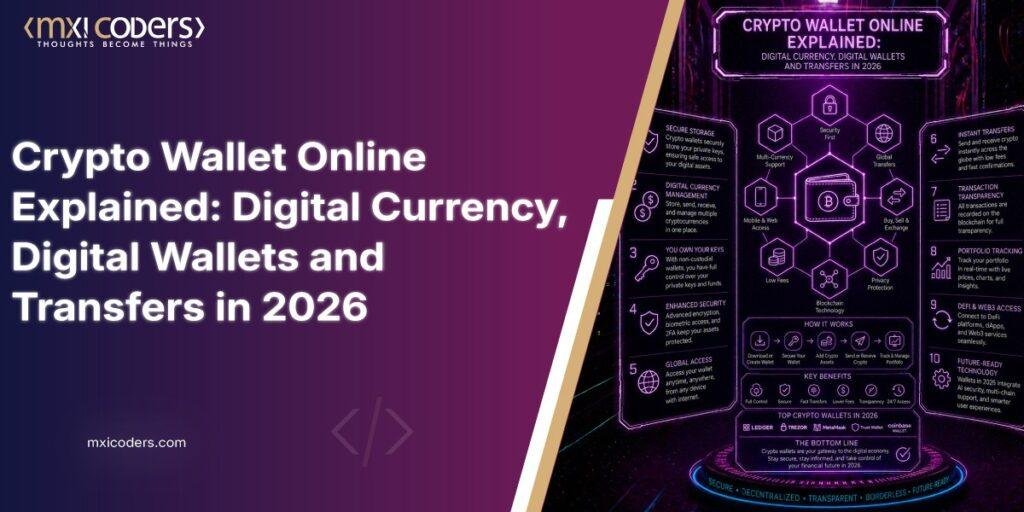
crypto wallet online explained (blog image)

A crypto wallet online lets you hold, send, and receive digital currency like Bitcoin or Ethereum without a bank in the middle. It stores the private keys that prove ownership on the blockchain, not the coins themselves, which is the single most important thing to understand before using one for online money transfer.

➤ What Is the Difference Between a Digital Wallet and a Crypto Wallet Online?

A digital wallet, the kind built into Apple Pay, Google Pay, or a banking app, stores tokenized versions of your existing bank cards and moves fiat currency through existing payment rails. A crypto wallet online does something structurally different. It generates and stores a private key, a cryptographic string that authorizes transactions directly on a blockchain, with no bank or card network involved at all. Both are “digital,” but only one of them removes the intermediary entirely.

This distinction matters more than it did a few years ago. Global cryptocurrency ownership reached 741 million people in 2025, up 12.4 percent from 659 million in 2024, according to Crypto.com’s Crypto Market Sizing Report. Bitcoin alone accounted for roughly 365 million of those owners. That’s not a niche experiment anymore, it’s a parallel payment rail that a meaningful share of the connected population now touches regularly.

➤ How Does a Crypto Wallet Online Actually Store Your Digital Currency?

OptionMechanismBest FitTrade-off
Custodial walletA third party, usually an exchange, holds your private keys on your behalfBeginners who want password recovery and customer supportYou don’t fully control your funds; exchange failures or freezes can block access
Non-custodial hot walletYou hold the private key, but it lives on an internet-connected app or deviceFrequent traders who need fast accessConstant internet connectivity increases exposure to phishing and malware
Non-custodial cold wallet (hardware)Private keys are generated and stored on an offline physical deviceLong-term holders prioritizing security over convenienceLosing the device or seed phrase without a backup means permanent loss of funds

Every wallet falls into one of two categories based on who controls the private key, and a second split based on whether that key ever touches the internet.Non-custodial wallets, both hot and cold combined, now make up roughly 59 percent of all crypto wallets in use, according to Sumsub’s 2026 wallet security analysis, which tracks a real shift toward self-custody as users grow wary of exchange-level breaches.

➤ Is Digital Currency a Practical Option for Online Money Transfer?

This is where digital currency earns its keep beyond speculation. Traditional cross-border transfers still rely on layers of correspondent banks, and each layer adds a fee. Global remittance flows reached roughly 905 billion dollars in 2024, a 4.6 percent increase from 865 billion the year before, according to World Bank estimates. Blockchain based transfers bypass most of those intermediary layers, which is why digital wallets built on crypto rails are increasingly used for remittance corridors where traditional fees run highest.

That said, digital preference for app based transfers is already well established even outside crypto. Visa’s Money Travels 2025 Digital Remittances Adoption Report, which surveyed 44,000 remitters across 20 countries, found that digital apps have become the clearly preferred method for sending and receiving remittances worldwide. Crypto wallets are competing for a share of a market that has already moved decisively away from cash and physical transfer counters.

Regulation is catching up too. The EU’s Markets in Crypto-Assets regulation, known as MiCA, entered into force on December 30, 2024, and set July 1, 2026 as the deadline for crypto asset service providers to hold a full European license. That single regulatory shift has pushed most wallet providers operating in Europe to formalize custody practices that were previously handled informally.

➤ What Are the Real Limitations of Using a Crypto Wallet Online?

None of this makes a crypto wallet a drop in replacement for a bank account, and it’s worth being direct about where it falls short. Non-custodial wallets have no customer support line, so a lost seed phrase means permanently lost funds, there is no recovery process. Custodial wallets remove that risk but reintroduce the exact counterparty risk crypto was designed to avoid, since the provider, not you, ultimately controls the keys. Transaction costs on public blockchains also rise and fall with network congestion, so “no fees” claims from a few years ago no longer hold in every case. And regulatory treatment still varies sharply by country, which affects both usability and tax reporting.

➤ Frequently asked questions

  1. Is Bitcoin still just a speculative asset, or is it used as actual digital currency in 2026?
    Both, in practice. It’s held as an investment by most owners, but it’s also used directly for cross-border payment and remittance in countries where banking access or currency stability is limited, particularly across parts of South Asia and Sub-Saharan Africa.
  2. Can I use a crypto wallet online without any technical background?
    Yes, custodial wallets from established exchanges function similarly to a banking app, with password recovery and support. The technical complexity mainly applies to non-custodial, self-custody setups.
  3. Does a crypto wallet online cost anything to use for money transfers?
    Custodial wallets often charge withdrawal or conversion fees. Non-custodial wallets only involve blockchain network fees, which vary with congestion rather than a fixed percentage.
  4. What happens if I lose access to a non-custodial wallet?
    If you lose both the device and the seed phrase backup, the funds are permanently unrecoverable. There is no third party who can restore access, which is the direct trade-off for having full control.

➤ Conclusion

Digital currency has moved a long way past the “freedom from banks” pitch that defined its early years. What’s actually happening in 2026 is more practical than ideological: crypto wallets online are becoming one more rail alongside digital wallets and traditional remittance networks, chosen when the fee structure, speed, or corridor makes sense, and skipped when it doesn’t. Understanding the mechanics, custodial versus non-custodial, hot versus cold, is what separates someone using this technology safely from someone learning the hard way why “not your keys, not your coins” became a common warning in the first place.

If you’re building a product in this space, from a crypto wallet to a full cryptocurrency exchange platform, the wallet architecture decisions above aren’t abstract, they directly shape your compliance obligations and your support burden.

Mxicoders builds custodial and non-custodial crypto wallet infrastructure, cryptocurrency exchange platforms, and BFSI-grade money transfer solutions for teams that need MiCA-aware architecture from day one. Book a free consultation to talk through your wallet or exchange build.

➤ Sources Used

  • Visa, Money Travels: 2025 Digital Remittances Adoption Report
  • Crypto.com, Crypto Market Sizing Report, February 16, 2026
  • Sumsub, Custodial vs Non-Custodial Wallets analysis, February 24, 2026
  • World Bank remittance data via Migration Data Portal

Feel free to Connect us on

Ready to transform your business with smart software solutions?

Harness the power of custom software development to streamline operations, reduce costs, and boost efficiency. Start by exploring cutting-edge approaches like cloud-native platforms, API-first architecture, and AI-driven automation to future-proof your systems and stay ahead of the competition.

Book free consultation

Let’s build your idea together and serve society.

Author

Ashok Rathod

Tech Consultant

Experience
25 Years
Growth Architect for Startups & SMEs | Blockchain, AI , MVP Development, & Data-Driven Marketing Expert.

Transform the Carbon Credit Industry

Build a Transparent, Scalable Carbon Credit Marketplace with Blockchain.

Index

Get in Touch

Ready to transform your ideas into reality? Contact our team today and let’s discuss your project.